Seven Most Deadly Sins of Stock Picking
Greed
Motivation and Destruction: Greed it's a interesting one. Where it's hard to know how greedy to go, or how much should I really want. You've got something that you want to make into something more. No problem with that. But too much greed will ensure your failure. Stop chasing that fast cash, this one is a ringer, this one is it thoughts and investing. Make sure you are not getting greedy, but still investing t Iwisely and not out of greed, motivation. Generations of stock market losers have proved that there's no such thing as a fast buck. But there are bucks to be made for those who can overcome their urges and avoid this sin, and the rest of the seven sins.
Gluttony, Envy, and Lust
When lusting about anything it's very unhealthy. Lust can leave you in the alley street with literally nothing. Especially in our commercial culture, fiscal gluttony is easily sparked by its sister sins, Envy and Lust. If you need to have the shiniest car on the block or the biggest granite countertops in all of Poshbottome Pointe, your absolute investment returns are sure to suffer.
Take this example, say Average Joe could invest and have a annual returns of 15% a year. (That would make you a very good investor -- so you shouldn't count on those kinds of returns.) For the example Average Joe is dreaming big. It still won't make you wealthy if you're earning that 15% on nothing. Remember: Buffett didn't get rich just by making great investments. He got rich by not wasting money that could be added to the kitty. Don't believe me? Do the math. No, wait, let us do it for you.
If you start with $1,000 and earn that 15% a year in a tax-free account, your money will be worth $87,500 after 30 years. Not too shabby. By contrast, if you can skip the gas station stops in the morning and bag a lunch a couple of times, you can scrape together a lousy $1,000 a year to add to your nest egg. The final result? $625,000. Drive an old clunker and ignore all those tempting incentive offers from keeping up with the jones, and then save the $500 a month you would have spent on coffee and cars, and you'll be looking at $3.3 million -- though perhaps not if you invest in GM, while it battles slowing sales and an expected earnings decline.
Yes, Averag Joe is now looking more like Donald Trump (okay we will not get carried away). But do the same at a more reasonable 8% rate of return, and you'll still end up with $730,000. The point is this: Unless you're already sitting on a pretty big pile of dough, your stuff-envy and financial gluttony will be a much bigger factor in your future financial independence than any magic you can conjure for your portfolio's performance. Control your urges accordingly.
Anger
If you don't know Anger around the stock market, then you have been to yahoo's message board before have you? Seriously, that at times can be the anger in and of itself just reading through those message boards or other stock forums. Anger is a natural reaction to adversity, but it's one that rational investors need to overcome if they hope to have consistent success.
Investing is an inherently risky activity that demands a hard look at the facts, good and bad. But a huge number of stock buyers view it like some kind of Sunday-afternoon competition. It's like a intense sports match, cheering on there team, but giving heck to the others! And the anger makes them blind to the negatives. Woe unto the drunk fan who points out the lack of steady revenues and complete absence of profits at a company like Lakers. Plenty of angry members of the Stinger crowd try to blame the others for any downtick, even though they can see for themselves the firm has minute sales; no profits; mystifying, short-lived management; and a CEO with long history of failures.
Mr. Crazy Fan, criticism of a company you own does not constitute an affront to your personal honor. Mr. I am right fan, my positive comments about your company's competitor in no way constitute an agreement to meet with pistols at dawn. That throbbing vein in your forehead is a good indication that you're fixated on the wrong things. Embrace the stuff that angries up your blood. You might learn something important.
Pride
I'm right, and everyone else is wrong. We all feel that way, so I'm not going to deliver a blanket condemnation of self-assurance. After all, acting on your convictions is part of the arrogance of investing. If everyone shares the same, correct opinion of a stock, then it must already be fairly priced. We are convinced we can find sweet bargains or future world-beaters ahead of the rest of the crowd. But not every time. If you believe that, you're in trouble.
That's the kind of pride that will kill investors over the long run. The problem is that, in individual cases, the market rewards the ignorant and the informed without pointing out which is which. It's nice to see the long-suffering shareholders finally catch a break, but it doesn't change the fact that plenty of people brought the suffering on themselves by ignoring the firm's consistently deteriorating financials to purchase a pig in a poke.
When a stock goes up, those who bought it purely because they like the product, or hate a competitor, will swear up and down that they are finally being rewarded for their smarts, but the truth is, they're just being rewarded. The trouble with being otherwise deluded is that such irrational pride and (in the long run) the odds, catch up with you. Investing is about maximizing returns, but you can't do that without minimizing risks. There is a difference between being right and being lucky. I've been lucky before in getting out at the right time, but the danger is taking particular pride in it. It scared me into being even more careful with my future decisions. You need to live and learn and plan for the future, ackowledge your winnings but most importantly your losing to grow and learn from them.
Sloth
Let's think a little more about being a sloth, and when it comes down to it sloth is being lazy. There's no room in investing for good, old-fashioned sloth aka laziness. If you are too lazy to look research your stock company, the stock companies nubmers and and proxy statements, you're setting yourself up for some major failures. Yet every day, we are treated to amazing examples of extreme investor laziness. There are countless times you hear about a stock, but then if you get caught into the one of the seven deadly sins of stock picking and decide to be to lazy to do your homework and research then your asking for trouble. Going strictly on hear say information, one person's picks, etc. We see them all the time...but don't get caught being lazy and not doing your homework!
The road to righteousness
Some of history's most successful investors have said it time and time again: The journey to stock market wealth doesn't require superior instincts, faster reflexes, or better information. What it does require is patience, perseverance, and the willingness to do some work and avoid the mistakes that others are too quick to make. If you can steer clear of the seven sins of stock picking, you'll already be one up on Wall Street. Always remember there is room for bears and bulls, but never any room for pigs on "The Street"!
Friday, April 14, 2006

Ten Commandments Debt Free Life Style 10. 10-20-70
Ten Commandments - debt free lifestyle
10. 10-20-70 - The suggestion income allocation is 10% for tithes, 20% for saving and 70% for spending. This can of course be modified by spending less so that tithes to a local Church and saving increase. Yet a more important debt needs to be dealt with, first and foremost, if we are to enjoy the abundant life.
10. 10-20-70 - The suggestion income allocation is 10% for tithes, 20% for saving and 70% for spending. This can of course be modified by spending less so that tithes to a local Church and saving increase. Yet a more important debt needs to be dealt with, first and foremost, if we are to enjoy the abundant life.
Ten Commandments Debt Free Life Style 9. Invest for the future, invest in eternity
Ten Commandments - debt free lifestyle
9. Invest for the future, invest in eternity - By simple spending less than what you earn, you can save for futre needs, emergencies and retirement. But beyond this life, one can store up treasures in heave (Matt. 6:20). Live simply that others can simply live. Instead of spending on something that is not a real need, give it away to someone who has a dire need. Be a major stakeholder in church by giving much of your time, talent, energy and money to it.
9. Invest for the future, invest in eternity - By simple spending less than what you earn, you can save for futre needs, emergencies and retirement. But beyond this life, one can store up treasures in heave (Matt. 6:20). Live simply that others can simply live. Instead of spending on something that is not a real need, give it away to someone who has a dire need. Be a major stakeholder in church by giving much of your time, talent, energy and money to it.
Ten Commandments Debt Free Life Style 8. Hardwork, not easy money
Ten Commandments - debt free lifestyle
8. Hardwork, not easy money - Work hard and become a leader, be lasy and never succeed. Do not gamble. Beware of pyramid schemes. Do not lend at high interest, aiming for the easy, quick bucks could spell more disaster!
8. Hardwork, not easy money - Work hard and become a leader, be lasy and never succeed. Do not gamble. Beware of pyramid schemes. Do not lend at high interest, aiming for the easy, quick bucks could spell more disaster!
Ten Commandments Debt Free Life Style 7. Gratefull and not greedy
Ten Commandments - debt free lifestyle
7. Grateful and not greedy - Giving generously to others may be the most rewarding gift to ever recieve! Just think about being content of where you are, and sharing of more what you have!
7. Grateful and not greedy - Giving generously to others may be the most rewarding gift to ever recieve! Just think about being content of where you are, and sharing of more what you have!
Ten Commandments Debt Free Life Style 6. Family Planning
Ten Commandments Debt - Free Life Style
6. Family Planning - More children means more mouths to feed, more bodies to clothe, more minds to educate, and that's right more family planning and budgeting for all the above. Plan a family of manageable size which you could supply as well as amply give care, love, and give full attention to. And just think of this world and how many children out there worldwide that are malnourished and out of school. And at the rate popluation is growing, in a few years, there will not be enough food to go around!
6. Family Planning - More children means more mouths to feed, more bodies to clothe, more minds to educate, and that's right more family planning and budgeting for all the above. Plan a family of manageable size which you could supply as well as amply give care, love, and give full attention to. And just think of this world and how many children out there worldwide that are malnourished and out of school. And at the rate popluation is growing, in a few years, there will not be enough food to go around!
Ten Commandments Debt Free Life Style 5. Envelopes of Cash
Ten Commandments - Debt Free Life Style
5. Envelopes of cash - Cash funds must be kept in envelopes distributed as follows: Monthly: rent, food, utility, gasoline, school allowance, recreational and entertainment, etc. Yearly: tuition, textbooks, and school supplies, insurance, Christmas, holidays. Contingencies: medical, emergencies. Also try to refrain from juggling funds.
Also, another way to help you put away some cash, is so many people are banking online, paying online, spending online. Then why not save online, that's right do a direct deposit of first paying yourself and leaving say $20 a month goes to first paying yourself for saving towards something maybe for a raining day, vacation, extra spending money for a later date, or even more to your retirement fund!
5. Envelopes of cash - Cash funds must be kept in envelopes distributed as follows: Monthly: rent, food, utility, gasoline, school allowance, recreational and entertainment, etc. Yearly: tuition, textbooks, and school supplies, insurance, Christmas, holidays. Contingencies: medical, emergencies. Also try to refrain from juggling funds.
Also, another way to help you put away some cash, is so many people are banking online, paying online, spending online. Then why not save online, that's right do a direct deposit of first paying yourself and leaving say $20 a month goes to first paying yourself for saving towards something maybe for a raining day, vacation, extra spending money for a later date, or even more to your retirement fund!
Ten Commandments Debt Free Life Style 4. Debt Pay-off ASAP
Ten Commandments - debt free lifestyle today!
4. Debt Pay-off ASAP - That's right...payoff your debt asap, because we all know that cash basis is the best! If your budget or cash resource allows you to pay the full amount reflect on the statment of account. This practice will pay off in the end. Paying only the minimum amount required may seem light on the pocket, but heavier in the long run due to interests rates which for a credit card can run anywhere from 3.25% to 30% (depending on how late or backed up you might be on the your payments). Here are the don't in borrowing!
* don't borrow to buy anything that depreciates
* don't borrow to pay back debt
* don't borrow at high interest
* don't borrow except to buy a house (which appreciates in value)
4. Debt Pay-off ASAP - That's right...payoff your debt asap, because we all know that cash basis is the best! If your budget or cash resource allows you to pay the full amount reflect on the statment of account. This practice will pay off in the end. Paying only the minimum amount required may seem light on the pocket, but heavier in the long run due to interests rates which for a credit card can run anywhere from 3.25% to 30% (depending on how late or backed up you might be on the your payments). Here are the don't in borrowing!
* don't borrow to buy anything that depreciates
* don't borrow to pay back debt
* don't borrow at high interest
* don't borrow except to buy a house (which appreciates in value)
Ten Commandments Debt Free Life Style 4. Debt Pay-off ASAP
Ten Commandments - debt free lifestyle today!
4. Debt Pay-off ASAP - That's right...payoff your debt asap, because we all know that cash basis is the best! If your budget or cash resource allows you to pay the full amount reflect on the statment of account. This practice will pay off in the end. Paying only the minimum amount required may seem light on the pocket, but heavier in the long run due to interests rates which for a credit card can run anywhere from 3.25% to 30% (depending on how late or backed up you might be on the your payments). Here are the don't in borrowing!
* don't borrow to buy anything that depreciates
* don't borrow to pay back debt
* don't borrow at high interest
* don't borrow except to buy a house (which appreciates in value)
4. Debt Pay-off ASAP - That's right...payoff your debt asap, because we all know that cash basis is the best! If your budget or cash resource allows you to pay the full amount reflect on the statment of account. This practice will pay off in the end. Paying only the minimum amount required may seem light on the pocket, but heavier in the long run due to interests rates which for a credit card can run anywhere from 3.25% to 30% (depending on how late or backed up you might be on the your payments). Here are the don't in borrowing!
* don't borrow to buy anything that depreciates
* don't borrow to pay back debt
* don't borrow at high interest
* don't borrow except to buy a house (which appreciates in value)
Thursday, April 13, 2006
What or where is the market going?
I think it would be nice to see the market crate in here, wring out
excessive fear, shoot confidence, create attractive valuations...
But I am afraid this may be wishful thinking. The reason the market
is so frustrating to both bulls and bears is because there aren't
really any events that can push it one way or the other.
Iran's nuclear ambitions are years away and they need money to
continue - oil is their only source of revenue...
High oil prices are inflationary and can slow the economy, but oil
is bid up on the expectation of continued demand - i.e. strong
economy, and each time there is a perception of slowing, oil prices
retreat from highs...
So the market continues its elaborate dance with oil and interest
rates in a narrowing range...
One area I am watching closely is oil services / related (ALJ, BAS,
NTG). If oil prices remain high, oil producers operating at
capacity may not be able to show explosive eps growth without new
discoveries or acqusitions. But they are likely to continue
drilling and pumping.
Though frustrating at times with the market. Just always remember
their is room for bears and bulls, but no room for pigs!!
excessive fear, shoot confidence, create attractive valuations...
But I am afraid this may be wishful thinking. The reason the market
is so frustrating to both bulls and bears is because there aren't
really any events that can push it one way or the other.
Iran's nuclear ambitions are years away and they need money to
continue - oil is their only source of revenue...
High oil prices are inflationary and can slow the economy, but oil
is bid up on the expectation of continued demand - i.e. strong
economy, and each time there is a perception of slowing, oil prices
retreat from highs...
So the market continues its elaborate dance with oil and interest
rates in a narrowing range...
One area I am watching closely is oil services / related (ALJ, BAS,
NTG). If oil prices remain high, oil producers operating at
capacity may not be able to show explosive eps growth without new
discoveries or acqusitions. But they are likely to continue
drilling and pumping.
Though frustrating at times with the market. Just always remember
their is room for bears and bulls, but no room for pigs!!
Ten Commandments Debt Free Life Style 3. Cut Credit Cards
Ten Commandments Debt Free Life Style
3. Cut Credit Cards - We know this sounds very very strict, but if your living debt this is probably a big problem! It's time to cut the credit cards that are leading or adding to the problem which is living in debt! Its time to buckle down and get rid of your credit cards!
3. Cut Credit Cards - We know this sounds very very strict, but if your living debt this is probably a big problem! It's time to cut the credit cards that are leading or adding to the problem which is living in debt! Its time to buckle down and get rid of your credit cards!
Ten Commandments Debt Free Life Style 2. Budget
Ten Commandments Debt Free Life Style
2. Budget - Yes, we know everyone sort of hates to hear that word budget. And you get that idea in you head of sitting down and number crunching. Budget does not always have to that boring. It's more of a simple record of what you are going to give yourself for different expenses per month. Some other important thoughts on budgeting is making some simple rules in budgeting and stick to them. Do not give in, if you set a goal or a budget for $50 a month on entertainment then stick to it! Trust me you will be better off for it in the long run. Make a record of all your expenses, have and stick with shopping lists, meaning don't buy anything that is not on the list, and lastly did we mention stick to your budget plans!
2. Budget - Yes, we know everyone sort of hates to hear that word budget. And you get that idea in you head of sitting down and number crunching. Budget does not always have to that boring. It's more of a simple record of what you are going to give yourself for different expenses per month. Some other important thoughts on budgeting is making some simple rules in budgeting and stick to them. Do not give in, if you set a goal or a budget for $50 a month on entertainment then stick to it! Trust me you will be better off for it in the long run. Make a record of all your expenses, have and stick with shopping lists, meaning don't buy anything that is not on the list, and lastly did we mention stick to your budget plans!
Ten Commandments Debt Free Life Style 1. Administrators
Ten Commandments - Debt Free Life Style
1. Administrators - We all must remember, acknowledge that fact that we are in living in a debt problem. Or that we do have some extra debt that we are needing to get out of. Also, the most important fact to remember is that God knows everything. We first and foremost have to be good stewards of the resourced that God has provided us for! A good reminder to keep thinking God owns all the cows in the world. With this thought in mind if He owns all the cows in the world then sure he will keep care of YOU!!
1. Administrators - We all must remember, acknowledge that fact that we are in living in a debt problem. Or that we do have some extra debt that we are needing to get out of. Also, the most important fact to remember is that God knows everything. We first and foremost have to be good stewards of the resourced that God has provided us for! A good reminder to keep thinking God owns all the cows in the world. With this thought in mind if He owns all the cows in the world then sure he will keep care of YOU!!
Debt Free Lifestyle, stressed about your taxes
Stressed about your taxes, looking at your taxes and can no figure out where you spent all your money that you have made. And then on top of that your still in debt, and you can not figure out why?
Ever thought of owe nothing to anyone, And you keep looking for real answers of how to do this in your lifestyle. Where or what can I do to get me out of debt. Well, I guess, there is not really easy steps to take, but we do want to try to offer some help. Though change is never easy, and especially money change, or habits dealing with money. Here are some tips or suggestions to relieve your stress, and start heading towards a debt ridden lifestyle!
So come back and check out our newest series of what we are calling!!!
The ten commandments for debt free lifestyle!
Ever thought of owe nothing to anyone, And you keep looking for real answers of how to do this in your lifestyle. Where or what can I do to get me out of debt. Well, I guess, there is not really easy steps to take, but we do want to try to offer some help. Though change is never easy, and especially money change, or habits dealing with money. Here are some tips or suggestions to relieve your stress, and start heading towards a debt ridden lifestyle!
So come back and check out our newest series of what we are calling!!!
The ten commandments for debt free lifestyle!
Did you know there are International ETF's
Q: Are there international ETFs?
There are many, including regional funds such as European or Pacific Rim funds, as well as individual country funds in relatively well-developed economies. In each of these countries there is an established index of reasonably large and liquid stocks that allows this to happen. As developing nations stabilize their stock markets, they will no doubt adopt ETFs.
Here are few that I think would be a research and look and invest at your own risk!
Check these out
BLDRS Asia 50 ADR Index (ADRA)
iShares FTSE/Xinhua China 25 Index (FXI)
iShares Nasdaq Biotechnology (IBB)
iShares Dow Jones Select Dividend Index (DVY)
iShares MSCI Germany Index (EWG)
iShares MSCI Japan Index (EWJ)
streetTRACKS Gold Shares (GLD)
PowerShares Gldn Dragon Halter USX China (PGJ)
PowerShares Dynamic Large Cap Value (PWV)
Vanguard Pacific Stock VIPERs (VPL)
There are many, including regional funds such as European or Pacific Rim funds, as well as individual country funds in relatively well-developed economies. In each of these countries there is an established index of reasonably large and liquid stocks that allows this to happen. As developing nations stabilize their stock markets, they will no doubt adopt ETFs.
Here are few that I think would be a research and look and invest at your own risk!
Check these out
BLDRS Asia 50 ADR Index (ADRA)
iShares FTSE/Xinhua China 25 Index (FXI)
iShares Nasdaq Biotechnology (IBB)
iShares Dow Jones Select Dividend Index (DVY)
iShares MSCI Germany Index (EWG)
iShares MSCI Japan Index (EWJ)
streetTRACKS Gold Shares (GLD)
PowerShares Gldn Dragon Halter USX China (PGJ)
PowerShares Dynamic Large Cap Value (PWV)
Vanguard Pacific Stock VIPERs (VPL)
Wednesday, April 12, 2006
Streicher Mobile (FUEL)
Streicher Mobile (FUEL) is in EXTREMELY high demand right now due to the fact that Ethanol can only be transported and distributed by trucks and rail...just read this, its from the EIA Department of Energy:
INTER-REGIONAL TRANSPORTATION ISSUES AND ASSOCIATED COSTS FOR RENEWABLE FUELS
Probably the largest issue associated with increased ethanol use is distribution. Since EIA has not performed detailed analysis of ethanol transportation issues, the EIA transportation paper largely summarizes recent work by Downstream Alternatives, Inc., (DAI) for the U.S. Department of Energy. The DAI analysis found that expanding the market for ethanol to 5.1 billion gallons per year results in an estimated average national cost of about 8 cents per gallon of ethanol to transport it to markets. This translates to a cost of about 1 cent per gallon of gasoline when 10 percent ethanol is used. Delivery infrastructure issues requiring attention before demand reaches this level include: rail terminals able to unload more than a few cars, constraints on the Inland Waterway System, and a possible shortage of Oil Pollution Act of 1990-compliant Jones Act vessels. However, our analysis concludes that the major transportation mode for ethanol will be rail. The number of entities needing to invest to make the needed infrastructure changes is large, and breakdowns in pieces of the chain could affect ultimate supply availability. This implies that the transitions beginning in 2004, particularly the large volumes of ethanol required to flow to California, could result in some initial supply dislocations and price volatility. Even after the transition periods, coastal RFG areas dependent on ethanol, which requires a separate distribution system from gasoline that includes railcar and water transport, could experience increased price volatility if distribution becomes hampered due to events such as flooding and winter storms, as has been the case with other fuel disruptions.
INTER-REGIONAL TRANSPORTATION ISSUES AND ASSOCIATED COSTS FOR RENEWABLE FUELS
Probably the largest issue associated with increased ethanol use is distribution. Since EIA has not performed detailed analysis of ethanol transportation issues, the EIA transportation paper largely summarizes recent work by Downstream Alternatives, Inc., (DAI) for the U.S. Department of Energy. The DAI analysis found that expanding the market for ethanol to 5.1 billion gallons per year results in an estimated average national cost of about 8 cents per gallon of ethanol to transport it to markets. This translates to a cost of about 1 cent per gallon of gasoline when 10 percent ethanol is used. Delivery infrastructure issues requiring attention before demand reaches this level include: rail terminals able to unload more than a few cars, constraints on the Inland Waterway System, and a possible shortage of Oil Pollution Act of 1990-compliant Jones Act vessels. However, our analysis concludes that the major transportation mode for ethanol will be rail. The number of entities needing to invest to make the needed infrastructure changes is large, and breakdowns in pieces of the chain could affect ultimate supply availability. This implies that the transitions beginning in 2004, particularly the large volumes of ethanol required to flow to California, could result in some initial supply dislocations and price volatility. Even after the transition periods, coastal RFG areas dependent on ethanol, which requires a separate distribution system from gasoline that includes railcar and water transport, could experience increased price volatility if distribution becomes hampered due to events such as flooding and winter storms, as has been the case with other fuel disruptions.
Two interesting stocks to watch for Thursday!!
Interesting raising stocks and volume:
These two stocks really struck me yesterday, and will be interesting to watch for today! Blue Dolphin Energy Co. (BDCO): shares of Houston, Texas based natural gas and oil exploration company jumped 40.12% or $2.03 to $7.09 as the company reported second consecutive profitable quarter. The stock is the leading gainer on Nasdaq today with 10.5 million shares traded, about 13 times average volumn.
This one was interesting too! Plug Power Inc.(PLUG): shares of Latham, NY based proton exchange membrance fuel cell technology company surged 22.54% or $1.1 to $5.98 on new investment from two Russian investment firm worth $217 million. The stock is the fifth leading advancer on Nasdaq today with 28.5 million shares traded, the twelveth most heaviest traded on Nasdaq.
These two stocks really struck me yesterday, and will be interesting to watch for today! Blue Dolphin Energy Co. (BDCO): shares of Houston, Texas based natural gas and oil exploration company jumped 40.12% or $2.03 to $7.09 as the company reported second consecutive profitable quarter. The stock is the leading gainer on Nasdaq today with 10.5 million shares traded, about 13 times average volumn.
This one was interesting too! Plug Power Inc.(PLUG): shares of Latham, NY based proton exchange membrance fuel cell technology company surged 22.54% or $1.1 to $5.98 on new investment from two Russian investment firm worth $217 million. The stock is the fifth leading advancer on Nasdaq today with 28.5 million shares traded, the twelveth most heaviest traded on Nasdaq.
Bausch & Lomb, bol, renu
Okay, so what's all this talk about Bausch & Lomb, and there product or lack of product called renu. These are the all the questions we are asking and wondering! Here is a little background info...the fungus, called Fusarium, is commonly found in plant material and soil in tropical and subtropical regions. Without eye-drop treatment, which can last two to three months, the infection can scar the cornea and blind its victims.
Symptoms can include blurry vision, pain or redness, increased sensitivity to light and excessive discharge from the eye. It is not transmitted from person to person.
In February, Bausch & Lomb stopped shipments of ReNu in Singapore and Hong Kong after a similar spike in infections was reported in contact-lens wearers there. It is partnering with health authorities and researchers to investigate the extent and cause of the outbreak, which also surfaced in Malaysia.
More than 30 million Americans wear contact lenses, and the ReNu brand generated $45 million in U.S. sales last year.
Well, so what's the word now...well everyone the street, and evening Kramer I think is saying SELL! It's up to you....what you want to do...but I would be jumping ship if I were a owner of stock in this one!
Symptoms can include blurry vision, pain or redness, increased sensitivity to light and excessive discharge from the eye. It is not transmitted from person to person.
In February, Bausch & Lomb stopped shipments of ReNu in Singapore and Hong Kong after a similar spike in infections was reported in contact-lens wearers there. It is partnering with health authorities and researchers to investigate the extent and cause of the outbreak, which also surfaced in Malaysia.
More than 30 million Americans wear contact lenses, and the ReNu brand generated $45 million in U.S. sales last year.
Well, so what's the word now...well everyone the street, and evening Kramer I think is saying SELL! It's up to you....what you want to do...but I would be jumping ship if I were a owner of stock in this one!
Monday, April 10, 2006
HIBB....looks to be good to us...but you do the research yourself!
HIBB
Let's take a little time to check this one out...so let's talk about Hibbett. Let's see if the stock still looks like it belongs or a buy.
First of all, their business. According to the Yahoo "Profile" on Hibbett, the company
"...operates sporting goods stores in small to mid-sized markets in the southeast, mid-atlantic, and midwest United States. The company, through its stores, offers athletic equipment, footwear, and apparel. As of February 2, 2006, it operated 549 Hibbett Sports stores, including smaller-format Sports Additions athletic shoe stores and larger format Sports & Co. superstores."
Let's check and see if there is any news of significance on the company.
The latest news appears to be the 4th quarter 2006 earnings report. Reported on March 9, 2006, the company reported:
"Net sales for the 13-week period ended January 28, 2006, increased 12.8% to $120.8 million compared with $107.1 million for the 13-week period ended January 29, 2005. Comparable store sales increased 2.5% in the fourth quarter of fiscal 2006. Net income for the fourth fiscal quarter increased 21.7% to $9.9 million compared with $8.1 million in the fourth fiscal quarter of last year. Earnings per diluted share increased 26.1% to $0.29 compared with $0.23 per diluted share in the prior year."
So from my perspective this was a satisfactory report. Revenue was up nicely, earnings were solid, but the same store sales gain of 2.5% is a bit anemic and I suspect that is why the stock price is currently consolidating instead of continuing to charge higher.
How about longer-term?
Looking at the Morningstar.com "5-Yr Restated" financials on HIBB is simply drop-dead gorgeous. This is a textbook example of what I am looking for in a stock. I mean talking about having all of your ducks in a row!
Revenue has steadily grown from $210 million in 2001 to $378 million in 2005 and $427 million in the trailing twelve months (TTM). Earnings have also been steadily growing from $.32/share in 2001 to $.71/share in 2005 and $.92/share in the TTM. Shares outstanding has also been fairly steady with 33 million in 2001, increasing to 35 million by 2005 and 36 million in the TTM.
Free cash flow? Also perfect imho. With $11 million in 2003, increasing to $33 million in 2005 and $35 million in the TTM.
What about the Morningstar.com reported balance sheet? Calculating the "current ratio", comparing the total current assets to the current liabilities, gives us a total of $155.2 million in current asets, balanced against $56.7 million in current liabilities--almost a current ratio of 3. The current assets can easily pay off the total combined liabilities of $70 million, more than two times over.
What about some valuation numbers on this stock?
Reviewing the Yahoo "Key Statistics" on Hibbett, we find that HIBB is a mid-cap stock with a market capitalization of $1.1 billion. The trailing p/e is a moderate 31.37, with a forward p/e (fye 28-Jan-08) of only 23.42. Calculating the PEG based on the 5 Yr Expected growth, gives us a PEG of only 1.19. Thus, valuation by this measure isn't bad at all.
According to the Fidelity.com eResearch website, Hibb is the 'priciest' of the stocks in the "Sporting Goods Stores" industrial group, with a Price/Sales ratio of 2.5. This is followed by Golf Galaxy (GGA) at 1.5, Dick's Sporting Goods (DKS) at 0.8, Big 5 Sporting Goods (BGFV) at 0.5, and Sports Authority (TSA) at 0.4. No bargain by this parameter!
Finishing up with Yahoo, we find that there are 35.71 million shares outstanding with 35.47 million of them that float. Currently there are 1.62 million shares out short (3/10/06) representing 4.60% of the float, or 7.2 trading days of volume. This number, if I use my arbitrary 3 day cut-off, looks significant to me and on any good news, the short-sellers could be subject to a bit of a squeeze as they scramble to cover. However, on the other hand, a heavy dose of short-sellers suggest investors who believe the stock should be trading lower.
Let's take a little time to check this one out...so let's talk about Hibbett. Let's see if the stock still looks like it belongs or a buy.
First of all, their business. According to the Yahoo "Profile" on Hibbett, the company
"...operates sporting goods stores in small to mid-sized markets in the southeast, mid-atlantic, and midwest United States. The company, through its stores, offers athletic equipment, footwear, and apparel. As of February 2, 2006, it operated 549 Hibbett Sports stores, including smaller-format Sports Additions athletic shoe stores and larger format Sports & Co. superstores."
Let's check and see if there is any news of significance on the company.
The latest news appears to be the 4th quarter 2006 earnings report. Reported on March 9, 2006, the company reported:
"Net sales for the 13-week period ended January 28, 2006, increased 12.8% to $120.8 million compared with $107.1 million for the 13-week period ended January 29, 2005. Comparable store sales increased 2.5% in the fourth quarter of fiscal 2006. Net income for the fourth fiscal quarter increased 21.7% to $9.9 million compared with $8.1 million in the fourth fiscal quarter of last year. Earnings per diluted share increased 26.1% to $0.29 compared with $0.23 per diluted share in the prior year."
So from my perspective this was a satisfactory report. Revenue was up nicely, earnings were solid, but the same store sales gain of 2.5% is a bit anemic and I suspect that is why the stock price is currently consolidating instead of continuing to charge higher.
How about longer-term?
Looking at the Morningstar.com "5-Yr Restated" financials on HIBB is simply drop-dead gorgeous. This is a textbook example of what I am looking for in a stock. I mean talking about having all of your ducks in a row!
Revenue has steadily grown from $210 million in 2001 to $378 million in 2005 and $427 million in the trailing twelve months (TTM). Earnings have also been steadily growing from $.32/share in 2001 to $.71/share in 2005 and $.92/share in the TTM. Shares outstanding has also been fairly steady with 33 million in 2001, increasing to 35 million by 2005 and 36 million in the TTM.
Free cash flow? Also perfect imho. With $11 million in 2003, increasing to $33 million in 2005 and $35 million in the TTM.
What about the Morningstar.com reported balance sheet? Calculating the "current ratio", comparing the total current assets to the current liabilities, gives us a total of $155.2 million in current asets, balanced against $56.7 million in current liabilities--almost a current ratio of 3. The current assets can easily pay off the total combined liabilities of $70 million, more than two times over.
What about some valuation numbers on this stock?
Reviewing the Yahoo "Key Statistics" on Hibbett, we find that HIBB is a mid-cap stock with a market capitalization of $1.1 billion. The trailing p/e is a moderate 31.37, with a forward p/e (fye 28-Jan-08) of only 23.42. Calculating the PEG based on the 5 Yr Expected growth, gives us a PEG of only 1.19. Thus, valuation by this measure isn't bad at all.
According to the Fidelity.com eResearch website, Hibb is the 'priciest' of the stocks in the "Sporting Goods Stores" industrial group, with a Price/Sales ratio of 2.5. This is followed by Golf Galaxy (GGA) at 1.5, Dick's Sporting Goods (DKS) at 0.8, Big 5 Sporting Goods (BGFV) at 0.5, and Sports Authority (TSA) at 0.4. No bargain by this parameter!
Finishing up with Yahoo, we find that there are 35.71 million shares outstanding with 35.47 million of them that float. Currently there are 1.62 million shares out short (3/10/06) representing 4.60% of the float, or 7.2 trading days of volume. This number, if I use my arbitrary 3 day cut-off, looks significant to me and on any good news, the short-sellers could be subject to a bit of a squeeze as they scramble to cover. However, on the other hand, a heavy dose of short-sellers suggest investors who believe the stock should be trading lower.
Tuesday, April 04, 2006
another example of free float
another example of free float
Majority of stocks(smallcaps) we cover have a market
cap under 1b, some 100m, 300m, microcaps sometimes dip
under 50m. The float can range from 1-10million, some
higher. The float is useless unless you have volume or
momentum come to the stock because of excellent
earnings, a good story etc. The smaller the float, the
greater chance of imbalances..the greater the
volatility in the stock, it can flow both
ways......"supply/demand"... big buyer(s) roll in and
momentum is born.
A stock like POSH will not get momentum just b/c of
its float, its EPS is in the red. MOMO traders want to
buy a bigger crib,not a baby crib. I'd even question
in the CEO buying a puny amount in anticipation of a
listing on the NASD, increase in volume was tiny and
was also in anticpation of the exchange switch. Looks
like someone wasn't wearing a bip since it listed on
NASD.
Majority of stocks(smallcaps) we cover have a market
cap under 1b, some 100m, 300m, microcaps sometimes dip
under 50m. The float can range from 1-10million, some
higher. The float is useless unless you have volume or
momentum come to the stock because of excellent
earnings, a good story etc. The smaller the float, the
greater chance of imbalances..the greater the
volatility in the stock, it can flow both
ways......"supply/demand"... big buyer(s) roll in and
momentum is born.
A stock like POSH will not get momentum just b/c of
its float, its EPS is in the red. MOMO traders want to
buy a bigger crib,not a baby crib. I'd even question
in the CEO buying a puny amount in anticipation of a
listing on the NASD, increase in volume was tiny and
was also in anticpation of the exchange switch. Looks
like someone wasn't wearing a bip since it listed on
NASD.
What is a float, definition of float, investing float
What exactly is a company's float?
The term "float" refers to the regular shares that a company has issued to the public that are available for investors to transact. This figure is derived by taking a company's outstanding shares and subtracting from it any restricted stock. (Restricted stock is stock that is under some sort of sales restriction: for example, stock that is held by insiders and cannot be traded because they are in a lock-up period following an initial public offering.)
A company's float is an important number for investors because it indicates how many shares are actually available to be bought and sold by the general investing public. The company is not responsible for how shares within the float are traded by the public - this is a function of the secondary market. Therefore, shares that are purchased, sold or even shorted by investors do not affect the float because these actions do not represent a change in the number of shares available for trade: they simply represent a redistribution of shares. Similarly, the creation and trading of options on a stock do not affect the float.
Still don't quite understand what a float is? Here's an example:
Say the SUNW Sun Micro Systems has 10,000,000 shares in total, but 3,000,000 shares are held by insiders who acquired these shares through some type of share distribution plan. Because the employees of SUNW are not allowed to trade these stocks for a certain period of time, they are considered to be restricted. Therefore, the company's float would be 7,000,000 (10,000,000 – 3,000,000 = 7,000,000). In other words, only 7,000,000 shares are available for trade by Joe and Jane America (or Canada, or China, or England, and so on).
It should also be noted that there is an inverse correlation between the size of a company's float and the volatility of the stock's price. This makes sense when you think about it: the greater the number of shares available for trade, the less volatility the stock will display because the harder it is for a smaller number of shares to move the price.
The term "float" refers to the regular shares that a company has issued to the public that are available for investors to transact. This figure is derived by taking a company's outstanding shares and subtracting from it any restricted stock. (Restricted stock is stock that is under some sort of sales restriction: for example, stock that is held by insiders and cannot be traded because they are in a lock-up period following an initial public offering.)
A company's float is an important number for investors because it indicates how many shares are actually available to be bought and sold by the general investing public. The company is not responsible for how shares within the float are traded by the public - this is a function of the secondary market. Therefore, shares that are purchased, sold or even shorted by investors do not affect the float because these actions do not represent a change in the number of shares available for trade: they simply represent a redistribution of shares. Similarly, the creation and trading of options on a stock do not affect the float.
Still don't quite understand what a float is? Here's an example:
Say the SUNW Sun Micro Systems has 10,000,000 shares in total, but 3,000,000 shares are held by insiders who acquired these shares through some type of share distribution plan. Because the employees of SUNW are not allowed to trade these stocks for a certain period of time, they are considered to be restricted. Therefore, the company's float would be 7,000,000 (10,000,000 – 3,000,000 = 7,000,000). In other words, only 7,000,000 shares are available for trade by Joe and Jane America (or Canada, or China, or England, and so on).
It should also be noted that there is an inverse correlation between the size of a company's float and the volatility of the stock's price. This makes sense when you think about it: the greater the number of shares available for trade, the less volatility the stock will display because the harder it is for a smaller number of shares to move the price.
Monday, April 03, 2006
some stocks, take them for what they are worth!
Here are 10 more stocks to be checking out and IBD backs these stocks up with there high rating on them! And I think they are very worth looking at. So check these stocks out and decide for yourself which one you want to take some investing in!
1. Netease.com (NTES) - Earnings Per Share Rating: 99.* The China-based Internet company has a three-year EPS growth rate of 97% and a three-year sales growth rate of 83%.
2. Hansen Natural (HANS) - EPS Rating: 99. On March 9, the beverage firm reported its ninth straight quarter of triple-digit profit growth.
3. F5 Networks (FFIV) - EPS Rating: 98. The maker of products used to manage Internet traffic has ridden its 50-day moving average higher since its Jan. 3 breakout.
4. Las Vegas Sands (LVS) - EPS Rating: 98. The casino operator is in the running with three other groups to build Singapore’s first casino resort. Annual return on equity at the end of 2005 was 25.9%.
5. OmniVision Technologies (OVTI) - EPS Rating: 97. Its image sensors were recently selected by a German automotive parts supplier for use in rearview cameras. Annual profit margin in 2005 hit a multi-year high of 27.3%.
6. Multi-Fineline Electronix (MFLX) - EPS Rating: 92. The maker of printed circuit boards used in cell phones, personal digital assistants and bar-code scanners recently announced plans to acquire Singapore-based MFS Technology for $500 million in cash and stock.
7. Hittite Microwave (HITT) - EPS Rating: 92. The recent new issue and maker of integrated circuits is just one of many emerging leaders in IBD’s Electronics-Semiconductor Mfg group. In mid-February, the chipmaker reported a 64% rise in Q4 profit of 23 cents a share, 4 cents above estimates.
8. Gilead Sciences (GILD) - EPS Rating: 99. Its bird flu vaccine – Tamiflu – has been selling well and two of its AIDS drugs continue show promise. The company has a three-year EPS growth rate of 75% and a three-year sales growth rate of 59%.
9. JLG Industries (JLG) - EPS Rating: 85. The maker of aerial work platforms has been a standout performer in IBD’s Machinery-Construction/Mining group. In the past 12 months, the stock has risen 196% compared to a 91% gain for its industry group.
10. Pike Electric (PEC) - EPS Rating: 84. The provider of outsourced electric distribution and transmission services went public in July 2005 at $14. In early February, the company said fiscal second-quarter profit surged 310% to 41 cents a share, well above views of 27 cents.
Out of some of more stock research on these stocks that were mentioned above. We would probably take NTES, GILD, OVIT, and PEC. We feel that these are the solid and very good ones to really check out more so!!
1. Netease.com (NTES) - Earnings Per Share Rating: 99.* The China-based Internet company has a three-year EPS growth rate of 97% and a three-year sales growth rate of 83%.
2. Hansen Natural (HANS) - EPS Rating: 99. On March 9, the beverage firm reported its ninth straight quarter of triple-digit profit growth.
3. F5 Networks (FFIV) - EPS Rating: 98. The maker of products used to manage Internet traffic has ridden its 50-day moving average higher since its Jan. 3 breakout.
4. Las Vegas Sands (LVS) - EPS Rating: 98. The casino operator is in the running with three other groups to build Singapore’s first casino resort. Annual return on equity at the end of 2005 was 25.9%.
5. OmniVision Technologies (OVTI) - EPS Rating: 97. Its image sensors were recently selected by a German automotive parts supplier for use in rearview cameras. Annual profit margin in 2005 hit a multi-year high of 27.3%.
6. Multi-Fineline Electronix (MFLX) - EPS Rating: 92. The maker of printed circuit boards used in cell phones, personal digital assistants and bar-code scanners recently announced plans to acquire Singapore-based MFS Technology for $500 million in cash and stock.
7. Hittite Microwave (HITT) - EPS Rating: 92. The recent new issue and maker of integrated circuits is just one of many emerging leaders in IBD’s Electronics-Semiconductor Mfg group. In mid-February, the chipmaker reported a 64% rise in Q4 profit of 23 cents a share, 4 cents above estimates.
8. Gilead Sciences (GILD) - EPS Rating: 99. Its bird flu vaccine – Tamiflu – has been selling well and two of its AIDS drugs continue show promise. The company has a three-year EPS growth rate of 75% and a three-year sales growth rate of 59%.
9. JLG Industries (JLG) - EPS Rating: 85. The maker of aerial work platforms has been a standout performer in IBD’s Machinery-Construction/Mining group. In the past 12 months, the stock has risen 196% compared to a 91% gain for its industry group.
10. Pike Electric (PEC) - EPS Rating: 84. The provider of outsourced electric distribution and transmission services went public in July 2005 at $14. In early February, the company said fiscal second-quarter profit surged 310% to 41 cents a share, well above views of 27 cents.
Out of some of more stock research on these stocks that were mentioned above. We would probably take NTES, GILD, OVIT, and PEC. We feel that these are the solid and very good ones to really check out more so!!
7 stocks worth looking to trade or worth researching for yourself
7 stocks worth looking to trade or worth researching for yourself
Raytheon (NYSE:RTN - News) raised its dividend by 9% and will increased its stock buyback program by $750 million. The fundamentals look on on this one, but only getting a 5 out of 10 for the long term side!
Cognos (NasdaqNM:COGN - News) beat earnings by $.10, announcing $0.48 EPS. We give this one a 6 out of 10 so it's on the positive, but just something to let you know about and maybe look into more. Research is the key!
Merix (NasdaqNM:MERX - News) beat earnings, announcing $0.14 EPS versus expected $.02.
Home Solutions (AMEX:HOM - News) missed by a penny, announcing $.09 versus expected $.10 EPS. This one is an interesting to keep an eye on!
Tom Online (NasdaqNM:TOMO - News) looks like a buy to strong buy and initiated with a buy at Brean Murray.
Blockbuster (NYSE:BBI - News) was raised to Peer Perform from Underperform at Bear Stearns. Beware, but this could be a good one...I mean really look around the block how many Blockbusters do you have around your neighborhood!
Bank of America downgraded Asyst (NasdaqNM:ASYT - News) to neutral from Buy. Long term, long term moving average, short term, and short term moving average are on looking like a go on this one!!
Raytheon (NYSE:RTN - News) raised its dividend by 9% and will increased its stock buyback program by $750 million. The fundamentals look on on this one, but only getting a 5 out of 10 for the long term side!
Cognos (NasdaqNM:COGN - News) beat earnings by $.10, announcing $0.48 EPS. We give this one a 6 out of 10 so it's on the positive, but just something to let you know about and maybe look into more. Research is the key!
Merix (NasdaqNM:MERX - News) beat earnings, announcing $0.14 EPS versus expected $.02.
Home Solutions (AMEX:HOM - News) missed by a penny, announcing $.09 versus expected $.10 EPS. This one is an interesting to keep an eye on!
Tom Online (NasdaqNM:TOMO - News) looks like a buy to strong buy and initiated with a buy at Brean Murray.
Blockbuster (NYSE:BBI - News) was raised to Peer Perform from Underperform at Bear Stearns. Beware, but this could be a good one...I mean really look around the block how many Blockbusters do you have around your neighborhood!
Bank of America downgraded Asyst (NasdaqNM:ASYT - News) to neutral from Buy. Long term, long term moving average, short term, and short term moving average are on looking like a go on this one!!
high yield stocks!
Here are some high yield stocks to be looking for. Remember it's important to check the volume and not only volume, but also daily volume. And you will note that all of these following high yield stocks have an daily average of over 500,000 volume. Also, all of thise high yield stocks have at least high yield of 4% or more!
Check these out, and keep your eye on those high yield stocks today!
Citigroup (NYSE:C) 47.23- 1.96 (4.10%)
AT & T (NYSE:T) 27.04 - 1.33 (4.90%)
Southern Copper (NYSE:PCU) 84.48 - 11.00 (13.00%)
Cedar Fair LP (NYSE:FUN) 29.25 - 1.88 (6.40%)
New Century Financial (NYSE:NEW) 46.02 - 7.00 (15.20%)
Lear Corp. (NYSE:LEA) 17.73 - 1.00 (5.60%)
Citizen Communications (NYSE:CZN) 13.27 - 1.00 (7.40%)
General Motors (NYSE:GM) 21.27 - 1.00 (4.70%)
Others to note that have high yield dividend
KNightsbridge Tankers (NasdaqNM:VLCCF) 25.06 - 3.20 (12.80%)
You take your pick on these great high yield dividend stocks
Check these out, and keep your eye on those high yield stocks today!
Citigroup (NYSE:C) 47.23- 1.96 (4.10%)
AT & T (NYSE:T) 27.04 - 1.33 (4.90%)
Southern Copper (NYSE:PCU) 84.48 - 11.00 (13.00%)
Cedar Fair LP (NYSE:FUN) 29.25 - 1.88 (6.40%)
New Century Financial (NYSE:NEW) 46.02 - 7.00 (15.20%)
Lear Corp. (NYSE:LEA) 17.73 - 1.00 (5.60%)
Citizen Communications (NYSE:CZN) 13.27 - 1.00 (7.40%)
General Motors (NYSE:GM) 21.27 - 1.00 (4.70%)
Others to note that have high yield dividend
KNightsbridge Tankers (NasdaqNM:VLCCF) 25.06 - 3.20 (12.80%)
You take your pick on these great high yield dividend stocks
Is wireless where it's at these days or what?
Wireless stocks, is this where it's at or not. After last Thursday we were beginning to wonder. Thursday the wireless stocks rallied pretty big, with Nokia leading the way with a strong forecast in cell phon growth globally this year.
Though you can not leave out Texas Instruments (up $1.01 to $33.00), TI is the number one maker of cell phone chips that counts Nokia as its biggest customer, saw its stock rise about 3 percent, and chipmaker RF Micro (up $0.37 to $8.69, Research), another large Nokia customer, gained about 4.5 percent.
Nokia (up $0.83 to $21.05)'s U.S. shares rallied nearly 4 percent, while rival Motorola (up $0.44 to $23.21) gained about 2 percent.
Nokia also launched three new phone models, unveiling the handsets in China as it targets new clients in fast-growing emerging markets, Reuters reported.
When talking wirelss you can never talk that without mentioning this one. Qualcomm (up $0.42 to $51.14), which makes integrated circuits and software for wireless products. Its shares rose as well.
We are thinking this one looks suprisely strong as well. Check this out for yourself, but it might be one to watch for little while and see for yourself. Skyworks (up $0.11 to $6.94, SWKS), which makes chips and integrated circuits for mobile phones.
A pair of analyst upgrades this week helped boost shares of the company, which had a difficult 2005 thanks to lost market share. Analysts think the company is poised to gain share from its rivals this year. Skyworks currently trades at around 30 times expected 2006 earnings.
In the small-cap front, you could look into this one Anadigics (up $0.11 to $7.46, ANAD), which makes integrated circuits.
Though you can not leave out Texas Instruments (up $1.01 to $33.00), TI is the number one maker of cell phone chips that counts Nokia as its biggest customer, saw its stock rise about 3 percent, and chipmaker RF Micro (up $0.37 to $8.69, Research), another large Nokia customer, gained about 4.5 percent.
Nokia (up $0.83 to $21.05)'s U.S. shares rallied nearly 4 percent, while rival Motorola (up $0.44 to $23.21) gained about 2 percent.
Nokia also launched three new phone models, unveiling the handsets in China as it targets new clients in fast-growing emerging markets, Reuters reported.
When talking wirelss you can never talk that without mentioning this one. Qualcomm (up $0.42 to $51.14), which makes integrated circuits and software for wireless products. Its shares rose as well.
We are thinking this one looks suprisely strong as well. Check this out for yourself, but it might be one to watch for little while and see for yourself. Skyworks (up $0.11 to $6.94, SWKS), which makes chips and integrated circuits for mobile phones.
A pair of analyst upgrades this week helped boost shares of the company, which had a difficult 2005 thanks to lost market share. Analysts think the company is poised to gain share from its rivals this year. Skyworks currently trades at around 30 times expected 2006 earnings.
In the small-cap front, you could look into this one Anadigics (up $0.11 to $7.46, ANAD), which makes integrated circuits.
Saturday, April 01, 2006
Limit Price Tip
Limit Price Tip
Here?s another term that we heard regularly during the stock market bubble of the 1990s but not much since the millennium. It?s an artificial ?circuit breaker? designed to prevent a spark of buying or selling from exploding into a full-blown panic.
The various futures markets set a ?limit? price before each session based on the settlement price at the end of the previous day?s trading. If the price of a particular futures contract hits the limit price, trading is suspended for a specific period of time. When trading resumes, the limit price is as far as the action can go. There is a ?limit up? for buying sprees and a ?limit down? for major sell-offs. If the contract is limit up or limit down for more than one day it is now ?lock limit.?
Future contracts cover a large number of commodities. Stock traders in particular watch the DOW futures and the NASDAQ 100 futures. The action in those futures pits, especially before the opening bell for a new session at the NYSE or NASDAQ, helps traders determine whether the open for the cash market will be strong or weak or going nowhere. If the DOW futures are soaring, traders tend to go long; if they?re collapsing, traders tend to go short.
Limits are set in place to prevent the buyers or sellers from taking the index too far, too quickly.
For example, the NASDAQ 100 has an initial limit at 20 points above or below the previous day?s settlement price. The limit is in effect for two minutes. When trading resumes, the next limit is at 30 points, and it is in effect for 15 minutes. Then comes 60 points for 30 minutes and 85 points for one hour. When the change is 100 index points up or down, it is at lock limit.
The limits are tested in most cases by news events. A horrible headline can send the futures to their limit in a flash. The last time we remember that occurring was in the aftermath of the 9-11 attack. The markets were closed from the start of the assault until the following Monday. The futures were at limit down before the start of trading, as we recall.
The goal is to allow people some time to catch their breath and digest the information that initiated the rash of buying or selling. Cooler heads usually prevail. After the limit is lifted, trading may still be frantic but not out of control. This is especially important during a sell-off. The last thing the exchanges want is a panic-induced rush to the exits that sends prices into an irreversible tailspin.
How should you, the individual investor, respond if you flip on CNBC one morning and see the DOW or NASDAQ futures at limit up or limit down? Not much, in most cases. Trying to buy shares in a run-up or dump shares in a major decline will probably result in a poor fill or no fill and a nasty case of whiplash from a whipsawing market.
However, if you have good day trading tools you can attempt to play the inevitable reversals. The market always overreacts; when the DOW drops 100 or 200 points in short order, it will come back before resuming its decline. Buying and then quickly selling an index-tracking Exchange Traded Fund, or ETF, could net some nice profits.
The same goes when the DOW or NASDAQ blast higher. The indexes will likely pause and decline for a spell as individual stock traders take their profits. At that point, short selling an ETF like the DOW ?Diamonds? (DIA) or NASDAQ ?Qubes? (QQQ) should work. ETFs, unlike stocks, have a special advantage because they don?t require waiting for an ?uptick,? or rise in price, before filling a short sale.
Here?s another term that we heard regularly during the stock market bubble of the 1990s but not much since the millennium. It?s an artificial ?circuit breaker? designed to prevent a spark of buying or selling from exploding into a full-blown panic.
The various futures markets set a ?limit? price before each session based on the settlement price at the end of the previous day?s trading. If the price of a particular futures contract hits the limit price, trading is suspended for a specific period of time. When trading resumes, the limit price is as far as the action can go. There is a ?limit up? for buying sprees and a ?limit down? for major sell-offs. If the contract is limit up or limit down for more than one day it is now ?lock limit.?
Future contracts cover a large number of commodities. Stock traders in particular watch the DOW futures and the NASDAQ 100 futures. The action in those futures pits, especially before the opening bell for a new session at the NYSE or NASDAQ, helps traders determine whether the open for the cash market will be strong or weak or going nowhere. If the DOW futures are soaring, traders tend to go long; if they?re collapsing, traders tend to go short.
Limits are set in place to prevent the buyers or sellers from taking the index too far, too quickly.
For example, the NASDAQ 100 has an initial limit at 20 points above or below the previous day?s settlement price. The limit is in effect for two minutes. When trading resumes, the next limit is at 30 points, and it is in effect for 15 minutes. Then comes 60 points for 30 minutes and 85 points for one hour. When the change is 100 index points up or down, it is at lock limit.
The limits are tested in most cases by news events. A horrible headline can send the futures to their limit in a flash. The last time we remember that occurring was in the aftermath of the 9-11 attack. The markets were closed from the start of the assault until the following Monday. The futures were at limit down before the start of trading, as we recall.
The goal is to allow people some time to catch their breath and digest the information that initiated the rash of buying or selling. Cooler heads usually prevail. After the limit is lifted, trading may still be frantic but not out of control. This is especially important during a sell-off. The last thing the exchanges want is a panic-induced rush to the exits that sends prices into an irreversible tailspin.
How should you, the individual investor, respond if you flip on CNBC one morning and see the DOW or NASDAQ futures at limit up or limit down? Not much, in most cases. Trying to buy shares in a run-up or dump shares in a major decline will probably result in a poor fill or no fill and a nasty case of whiplash from a whipsawing market.
However, if you have good day trading tools you can attempt to play the inevitable reversals. The market always overreacts; when the DOW drops 100 or 200 points in short order, it will come back before resuming its decline. Buying and then quickly selling an index-tracking Exchange Traded Fund, or ETF, could net some nice profits.
The same goes when the DOW or NASDAQ blast higher. The indexes will likely pause and decline for a spell as individual stock traders take their profits. At that point, short selling an ETF like the DOW ?Diamonds? (DIA) or NASDAQ ?Qubes? (QQQ) should work. ETFs, unlike stocks, have a special advantage because they don?t require waiting for an ?uptick,? or rise in price, before filling a short sale.
Friday, March 31, 2006
stock fall, cut your loses, stock loses
Do you still believe in the rule that you should sell if your stocks fall 10%? With it being so hard to determine Fact from Rumor how can you be sure it's the right thing to do?
Yes, it's very important to stick to your guns -- in fact, more than ever. As discussed above, investors that've been utterly wiped out by stocks like Lucent, Enron and Worldcom probably wished they'd cut their losses at 10% when the companies were still "good companies." The good thing about having a 10% rule is that you never have to separate between fact and rumor -- since you protect yourself no matter what.
Yes, it's very important to stick to your guns -- in fact, more than ever. As discussed above, investors that've been utterly wiped out by stocks like Lucent, Enron and Worldcom probably wished they'd cut their losses at 10% when the companies were still "good companies." The good thing about having a 10% rule is that you never have to separate between fact and rumor -- since you protect yourself no matter what.
What Fundamentals
So your looking to invest in individual stocks for the long term. What fundamentals are most important to look at now if there is a recovery in the markets? Are companies with a lot of cash on hand able to do better once a recovery takes hold? And what sectors do best in the current market we are facing?? Thanks for answering...sorry there are so many questions....
Actually, sitting on a pile of cash is more of an advantage going INTO a slowdown than coming out of one. Coming out of recession, those firms that used cash to expand during the downturn will fare best. Also, if you think a recovery is coming you'll want to be buying stocks in "cyclical" industries -- such as health care and bio. And you'll want to avoid stocks in consumer staples, such as groceries, drugs and consumer products.
Do you still believe in the rule that you should sell if your stocks fall 10%? With it being so hard to determine Fact from Rumor how can you be sure it's the right thing to do?
Matt Krantz: Absolutely -- in fact, more than ever. As discussed above, investors that've been utterly wiped out by stocks like Lucent, Enron and Worldcom probably wished they'd cut their losses at 10% when the companies were still "good companies." The good thing about having a 10% rule is that you never have to separate between fact and rumor -- since you protect yourself no matter what.
Actually, sitting on a pile of cash is more of an advantage going INTO a slowdown than coming out of one. Coming out of recession, those firms that used cash to expand during the downturn will fare best. Also, if you think a recovery is coming you'll want to be buying stocks in "cyclical" industries -- such as health care and bio. And you'll want to avoid stocks in consumer staples, such as groceries, drugs and consumer products.
Do you still believe in the rule that you should sell if your stocks fall 10%? With it being so hard to determine Fact from Rumor how can you be sure it's the right thing to do?
Matt Krantz: Absolutely -- in fact, more than ever. As discussed above, investors that've been utterly wiped out by stocks like Lucent, Enron and Worldcom probably wished they'd cut their losses at 10% when the companies were still "good companies." The good thing about having a 10% rule is that you never have to separate between fact and rumor -- since you protect yourself no matter what.
the question we get about stocks!
We get this question a lot: Could you suggest a few stocks for me to invest for my sons education something longterm and that has a proven track record?
So here is our answer for you all!!
First of all, no stocks should be trusted automatically, and every investment hold some risk. No matter what you buy, you should monitor stocks on a weekly if not daily basis to make sure nothing material has changed.
With that said, there are ways to find stocks that might fit your needs. A great place to start is by visiting yahoo finance/ and using the site's screening products. Look for companies with return on equity over the past five years of at least 15% and those with five-year earnings per share growth of at least 12% and revenue growth during the period of at least 10%. If you find some stocks you'd like to learn more about please be willing to share with us!
Keep investing wisely!
So here is our answer for you all!!
First of all, no stocks should be trusted automatically, and every investment hold some risk. No matter what you buy, you should monitor stocks on a weekly if not daily basis to make sure nothing material has changed.
With that said, there are ways to find stocks that might fit your needs. A great place to start is by visiting yahoo finance/ and using the site's screening products. Look for companies with return on equity over the past five years of at least 15% and those with five-year earnings per share growth of at least 12% and revenue growth during the period of at least 10%. If you find some stocks you'd like to learn more about please be willing to share with us!
Keep investing wisely!
Sunday, March 26, 2006
CPST
CPST
I've been given permission to post this under $4 stock, which
hopefully will be over 4 soon. This is a speculative stock.It moves on news and technicals, no earnings. Thursday AH this stock popped and I couldn't find out why till Friday when it was still making a move. Peter Worden evidently had
posted AH Thurs on the stock, and that's when I e-mailed Demi saying
take a look, "see any news" Couldn't find anything.......Anyway
here's a link to what got it moving, I believe.
some cpst news
This company has lot's in the fire right now that could get it
hopping, at anytime. The first thing that brought my attention to it
was sad to say "Cramer" But that has long since past. Walmart may
use these turbines in their "green" stores. The US gov't has
approved them as a supplier, known as GSA approval.CPST is the only
microturbine co. to be awared this approval, which is worth noting.
That doesn't mean the gov,t is buying from them at this time , just
that they have been approved. But the potential is there. Some of
their turbines have just recently been UL certified. The best thing
to do is look at their website and yahoo finance for the latest,
just too much to post here. This is an excerpt from RM's Michael
Soni, March 9,2006."I am currently focused on Capstone Turbine (CPST:Nasdaq -
commentary - research - Cramer's Take). It is the world's leading
producer of low-emission microturbine systems, which generate power
in a more efficient and environmentally-friendly manner.
Capstone recently unveiled, with FuelCell Energy (FCEL:Nasdaq -
commentary - research - Cramer's Take), a newly operational fuel
cell/microturbine hybrid energy system. The system boasted a 56%
efficiency rate for 800 continuous hours during initial testing, and
is slated to be installed at a hospital in Montana. These types of
products are ideal for commercial and industrial customers
interested in reducing energy costs.
Trading in Capstone has been very good, and volume has picked up
nicely. The stock went from around $1 in the summer of 2005 to
almost $6 in the fall of 2005. Volume and liquidity are very good,
with average volume around 2.6 million shares per day. The stock,
after correcting from $6, has been trending sideways from $3 to $4
since November 2005. Capstone is currently 78% undervalued based on
the Value Engine model and maintains an IBD rating of 23. This is a
rather low rating, but is a reflection of the past, and I believe
that earnings will catch up. The growth potential is strong and the
environment is ripe.
My expectation is that the stock will break out again very soon
based on a forming technical pattern called a pennant, which tends
to indicate higher prices. Keep an eye on the stock and look to take
a position on a break above $4. Capstone has exhibited explosive
growth, so expect it to move quickly when it does break out.
Maybe we could suggest a stop loss at $2.25.
I've been given permission to post this under $4 stock, which
hopefully will be over 4 soon. This is a speculative stock.It moves on news and technicals, no earnings. Thursday AH this stock popped and I couldn't find out why till Friday when it was still making a move. Peter Worden evidently had
posted AH Thurs on the stock, and that's when I e-mailed Demi saying
take a look, "see any news" Couldn't find anything.......Anyway
here's a link to what got it moving, I believe.
some cpst news
This company has lot's in the fire right now that could get it
hopping, at anytime. The first thing that brought my attention to it
was sad to say "Cramer" But that has long since past. Walmart may
use these turbines in their "green" stores. The US gov't has
approved them as a supplier, known as GSA approval.CPST is the only
microturbine co. to be awared this approval, which is worth noting.
That doesn't mean the gov,t is buying from them at this time , just
that they have been approved. But the potential is there. Some of
their turbines have just recently been UL certified. The best thing
to do is look at their website and yahoo finance for the latest,
just too much to post here. This is an excerpt from RM's Michael
Soni, March 9,2006."I am currently focused on Capstone Turbine (CPST:Nasdaq -
commentary - research - Cramer's Take). It is the world's leading
producer of low-emission microturbine systems, which generate power
in a more efficient and environmentally-friendly manner.
Capstone recently unveiled, with FuelCell Energy (FCEL:Nasdaq -
commentary - research - Cramer's Take), a newly operational fuel
cell/microturbine hybrid energy system. The system boasted a 56%
efficiency rate for 800 continuous hours during initial testing, and
is slated to be installed at a hospital in Montana. These types of
products are ideal for commercial and industrial customers
interested in reducing energy costs.
Trading in Capstone has been very good, and volume has picked up
nicely. The stock went from around $1 in the summer of 2005 to
almost $6 in the fall of 2005. Volume and liquidity are very good,
with average volume around 2.6 million shares per day. The stock,
after correcting from $6, has been trending sideways from $3 to $4
since November 2005. Capstone is currently 78% undervalued based on
the Value Engine model and maintains an IBD rating of 23. This is a
rather low rating, but is a reflection of the past, and I believe
that earnings will catch up. The growth potential is strong and the
environment is ripe.
My expectation is that the stock will break out again very soon
based on a forming technical pattern called a pennant, which tends
to indicate higher prices. Keep an eye on the stock and look to take
a position on a break above $4. Capstone has exhibited explosive
growth, so expect it to move quickly when it does break out.
Maybe we could suggest a stop loss at $2.25.
Monday, March 20, 2006
Borrowing Money To Pay for Stocks
Margin:
Borrowing Money To Pay for Stocks
"Margin" is borrowing money from your broker to buy a stock and using your investment as collateral. Investors generally use margin to increase their purchasing power so that they can own more stock without fully paying for it. But margin exposes investors to the potential for higher losses. Here's what you need to know about margin.
Understand How Margin Works
Let's say you buy a stock for $50 and the price of the stock rises to $75. If you bought the stock in a cash account and paid for it in full, you'll earn a 50 percent return on your investment. But if you bought the stock on margin – paying $25 in cash and borrowing $25 from your broker – you'll earn a 100 percent return on the money you invested. Of course, you'll still owe your firm $25 plus interest.
The downside to using margin is that if the stock price decreases, substantial losses can mount quickly. For example, let's say the stock you bought for $50 falls to $25. If you fully paid for the stock, you'll lose 50 percent of your money. But if you bought on margin, you'll lose 100 percent, and you still must come up with the interest you owe on the loan.
In volatile markets, investors who put up an initial margin payment for a stock may, from time to time, be required to provide additional cash if the price of the stock falls. Some investors have been shocked to find out that the brokerage firm has the right to sell their securities that were bought on margin – without any notification and potentially at a substantial loss to the investor. If your broker sells your stock after the price has plummeted, then you've lost out on the chance to recoup your losses if the market bounces back.
Recognize the Risks
Margin accounts can be very risky and they are not suitable for everyone. Before opening a margin account, you should fully understand that:
* You can lose more money than you have invested;
* You may have to deposit additional cash or securities in your account on short notice to cover market losses;
* You may be forced to sell some or all of your securities when falling stock prices reduce the value of your securities; and
* Your brokerage firm may sell some or all of your securities without consulting you to pay off the loan it made to you.
You can protect yourself by knowing how a margin account works and what happens if the price of the stock purchased on margin declines. Know that your firm charges you interest for borrowing money and how that will affect the total return on your investments. Be sure to ask your broker whether it makes sense for you to trade on margin in light of your financial resources, investment objectives, and tolerance for risk.
Read Your Margin Agreement
To open a margin account, your broker is required to obtain your signature. The agreement may be part of your account opening agreement or may be a separate agreement. The margin agreement states that you must abide by the rules of the Federal Reserve Board, the New York Stock Exchange, the National Association of Securities Dealers, Inc., and the firm where you have set up your margin account. Be sure to carefully review the agreement before you sign it.
As with most loans, the margin agreement explains the terms and conditions of the margin account. The agreement describes how the interest on the loan is calculated, how you are responsible for repaying the loan, and how the securities you purchase serve as collateral for the loan. Carefully review the agreement to determine what notice, if any, your firm must give you before selling your securities to collect the money you have borrowed.
Know the Margin Rules
The Federal Reserve Board and many self-regulatory organizations (SROs), such as the NYSE and NASD, have rules that govern margin trading. Brokerage firms can establish their own requirements as long as they are at least as restrictive as the Federal Reserve Board and SRO rules. Here are some of the key rules you should know:
Before You Trade – Minimum Margin
Before trading on margin, the NYSE and NASD, for example, require you to deposit with your brokerage firm a minimum of $2,000 or 100 percent of the purchase price, whichever is less. This is known as the "minimum margin." Some firms may require you to deposit more than $2,000.
Amount You Can Borrow – Initial Margin
According to Regulation T of the Federal Reserve Board, you may borrow up to 50 percent of the purchase price of securities that can be purchased on margin. This is known as the "initial margin." Some firms require you to deposit more than 50 percent of the purchase price. Also be aware that not all securities can be purchased on margin.
Amount You Need After You Trade – Maintenance Margin
After you buy stock on margin, the NYSE and NASD require you to keep a minimum amount of equity in your margin account. The equity in your account is the value of your securities less how much you owe to your brokerage firm. The rules require you to have at least 25 percent of the total market value of the securities in your margin account at all times. The 25 percent is called the "maintenance requirement." In fact, many brokerage firms have higher maintenance requirements, typically between 30 to 40 percent, and sometimes higher depending on the type of stock purchased.
Here's an example of how maintenance requirements work. Let's say you purchase $16,000 worth of securities by borrowing $8,000 from your firm and paying $8,000 in cash or securities. If the market value of the securities drops to $12,000, the equity in your account will fall to $4,000 ($12,000 - $8,000 = $4,000). If your firm has a 25 percent maintenance requirement, you must have $3,000 in equity in your account (25 percent of $12,000 = $3,000). In this case, you do have enough equity because the $4,000 in equity in your account is greater than the $3,000 maintenance requirement.
But if your firm has a maintenance requirement of 40 percent, you would not have enough equity. The firm would require you to have $4,800 in equity (40 percent of $12,000 = $4,800). Your $4,000 in equity is less than the firm's $4,800 maintenance requirement. As a result, the firm may issue you a "margin call," since the equity in your account has fallen $800 below the firm's maintenance requirement.
Understand Margin Calls – You Can Lose Your Money Fast and With No Notice
If your account falls below the firm's maintenance requirement, your firm generally will make a margin call to ask you to deposit more cash or securities into your account. If you are unable to meet the margin call, your firm will sell your securities to increase the equity in your account up to or above the firm's maintenance requirement.
Always remember that your broker may not be required to make a margin call or otherwise tell you that your account has fallen below the firm's maintenance requirement. Your broker may be able to sell your securities at any time without consulting you first. Under most margin agreements, even if your firm offers to give you time to increase the equity in your account, it can sell your securities without waiting for you to meet the margin call.
Ask Yourself These Key Questions
*
Do you know that margin accounts involve a great deal more risk than cash accounts where you fully pay for the securities you purchase? Are you aware you may lose more than the amount of money you initially invested when buying on margin? Can you afford to lose more money than the amount you have invested?
*
Did you take the time to read the margin agreement? Did you ask your broker questions about how a margin account works and whether it's appropriate for you to trade on margin? Did your broker explain the terms and conditions of the margin agreement?
*
Are you aware of the costs you will be charged on money you borrow from your firm and how these costs affect your overall return?
*
Are you aware that your brokerage firm can sell your securities without notice to you when you don't have sufficient equity in your margin account?
Borrowing Money To Pay for Stocks
"Margin" is borrowing money from your broker to buy a stock and using your investment as collateral. Investors generally use margin to increase their purchasing power so that they can own more stock without fully paying for it. But margin exposes investors to the potential for higher losses. Here's what you need to know about margin.
Understand How Margin Works
Let's say you buy a stock for $50 and the price of the stock rises to $75. If you bought the stock in a cash account and paid for it in full, you'll earn a 50 percent return on your investment. But if you bought the stock on margin – paying $25 in cash and borrowing $25 from your broker – you'll earn a 100 percent return on the money you invested. Of course, you'll still owe your firm $25 plus interest.
The downside to using margin is that if the stock price decreases, substantial losses can mount quickly. For example, let's say the stock you bought for $50 falls to $25. If you fully paid for the stock, you'll lose 50 percent of your money. But if you bought on margin, you'll lose 100 percent, and you still must come up with the interest you owe on the loan.
In volatile markets, investors who put up an initial margin payment for a stock may, from time to time, be required to provide additional cash if the price of the stock falls. Some investors have been shocked to find out that the brokerage firm has the right to sell their securities that were bought on margin – without any notification and potentially at a substantial loss to the investor. If your broker sells your stock after the price has plummeted, then you've lost out on the chance to recoup your losses if the market bounces back.
Recognize the Risks
Margin accounts can be very risky and they are not suitable for everyone. Before opening a margin account, you should fully understand that:
* You can lose more money than you have invested;
* You may have to deposit additional cash or securities in your account on short notice to cover market losses;
* You may be forced to sell some or all of your securities when falling stock prices reduce the value of your securities; and
* Your brokerage firm may sell some or all of your securities without consulting you to pay off the loan it made to you.
You can protect yourself by knowing how a margin account works and what happens if the price of the stock purchased on margin declines. Know that your firm charges you interest for borrowing money and how that will affect the total return on your investments. Be sure to ask your broker whether it makes sense for you to trade on margin in light of your financial resources, investment objectives, and tolerance for risk.
Read Your Margin Agreement
To open a margin account, your broker is required to obtain your signature. The agreement may be part of your account opening agreement or may be a separate agreement. The margin agreement states that you must abide by the rules of the Federal Reserve Board, the New York Stock Exchange, the National Association of Securities Dealers, Inc., and the firm where you have set up your margin account. Be sure to carefully review the agreement before you sign it.
As with most loans, the margin agreement explains the terms and conditions of the margin account. The agreement describes how the interest on the loan is calculated, how you are responsible for repaying the loan, and how the securities you purchase serve as collateral for the loan. Carefully review the agreement to determine what notice, if any, your firm must give you before selling your securities to collect the money you have borrowed.
Know the Margin Rules
The Federal Reserve Board and many self-regulatory organizations (SROs), such as the NYSE and NASD, have rules that govern margin trading. Brokerage firms can establish their own requirements as long as they are at least as restrictive as the Federal Reserve Board and SRO rules. Here are some of the key rules you should know:
Before You Trade – Minimum Margin
Before trading on margin, the NYSE and NASD, for example, require you to deposit with your brokerage firm a minimum of $2,000 or 100 percent of the purchase price, whichever is less. This is known as the "minimum margin." Some firms may require you to deposit more than $2,000.
Amount You Can Borrow – Initial Margin
According to Regulation T of the Federal Reserve Board, you may borrow up to 50 percent of the purchase price of securities that can be purchased on margin. This is known as the "initial margin." Some firms require you to deposit more than 50 percent of the purchase price. Also be aware that not all securities can be purchased on margin.
Amount You Need After You Trade – Maintenance Margin
After you buy stock on margin, the NYSE and NASD require you to keep a minimum amount of equity in your margin account. The equity in your account is the value of your securities less how much you owe to your brokerage firm. The rules require you to have at least 25 percent of the total market value of the securities in your margin account at all times. The 25 percent is called the "maintenance requirement." In fact, many brokerage firms have higher maintenance requirements, typically between 30 to 40 percent, and sometimes higher depending on the type of stock purchased.
Here's an example of how maintenance requirements work. Let's say you purchase $16,000 worth of securities by borrowing $8,000 from your firm and paying $8,000 in cash or securities. If the market value of the securities drops to $12,000, the equity in your account will fall to $4,000 ($12,000 - $8,000 = $4,000). If your firm has a 25 percent maintenance requirement, you must have $3,000 in equity in your account (25 percent of $12,000 = $3,000). In this case, you do have enough equity because the $4,000 in equity in your account is greater than the $3,000 maintenance requirement.
But if your firm has a maintenance requirement of 40 percent, you would not have enough equity. The firm would require you to have $4,800 in equity (40 percent of $12,000 = $4,800). Your $4,000 in equity is less than the firm's $4,800 maintenance requirement. As a result, the firm may issue you a "margin call," since the equity in your account has fallen $800 below the firm's maintenance requirement.
Understand Margin Calls – You Can Lose Your Money Fast and With No Notice
If your account falls below the firm's maintenance requirement, your firm generally will make a margin call to ask you to deposit more cash or securities into your account. If you are unable to meet the margin call, your firm will sell your securities to increase the equity in your account up to or above the firm's maintenance requirement.
Always remember that your broker may not be required to make a margin call or otherwise tell you that your account has fallen below the firm's maintenance requirement. Your broker may be able to sell your securities at any time without consulting you first. Under most margin agreements, even if your firm offers to give you time to increase the equity in your account, it can sell your securities without waiting for you to meet the margin call.
Ask Yourself These Key Questions
*
Do you know that margin accounts involve a great deal more risk than cash accounts where you fully pay for the securities you purchase? Are you aware you may lose more than the amount of money you initially invested when buying on margin? Can you afford to lose more money than the amount you have invested?
*
Did you take the time to read the margin agreement? Did you ask your broker questions about how a margin account works and whether it's appropriate for you to trade on margin? Did your broker explain the terms and conditions of the margin agreement?
*
Are you aware of the costs you will be charged on money you borrow from your firm and how these costs affect your overall return?
*
Are you aware that your brokerage firm can sell your securities without notice to you when you don't have sufficient equity in your margin account?
Investors, please take note
Investors, take note
If you keep good records, you’re more likely to prevail in a dispute with your broker. So say state securities regulators who have come up with a handy checklist for investors to fill in while they’re on the phone with their financial professional. The checklist takes minutes to complete, but could help to save a lot of grief and money.
The checklist prompts investors to record information such as the date of the broker’s call, the nature of the investment, how it was described to them, the broker’s name and their CRD number.
The CRD number corresponds to the broker’s record in the Central Registration Depository, a computer database jointly owned by state regulators and NASD. Investors should always check the CRD to see if the broker and their firm are registered in the investor’s state and to determine what, if any, disciplinary history they may have with regulators. To check a broker’s CRD record, investors can call their state regulator or the NASD’s public disclosure hotline at 800-289-9999.
Investors who keep good records of their dealings with their brokers have a leg up in any dispute. While the vast majority of brokers are honest, hard-working professionals, disputes do arise. Plus the kinds of questions the checklist prompts you to ask--like, ‘What’s your CRD number?’--could scare away some of the unscrupulous or dishonest brokers. The money you invest represents your financial future, so you need to keep close track of it.
If you keep good records, you’re more likely to prevail in a dispute with your broker. So say state securities regulators who have come up with a handy checklist for investors to fill in while they’re on the phone with their financial professional. The checklist takes minutes to complete, but could help to save a lot of grief and money.
The checklist prompts investors to record information such as the date of the broker’s call, the nature of the investment, how it was described to them, the broker’s name and their CRD number.
The CRD number corresponds to the broker’s record in the Central Registration Depository, a computer database jointly owned by state regulators and NASD. Investors should always check the CRD to see if the broker and their firm are registered in the investor’s state and to determine what, if any, disciplinary history they may have with regulators. To check a broker’s CRD record, investors can call their state regulator or the NASD’s public disclosure hotline at 800-289-9999.
Investors who keep good records of their dealings with their brokers have a leg up in any dispute. While the vast majority of brokers are honest, hard-working professionals, disputes do arise. Plus the kinds of questions the checklist prompts you to ask--like, ‘What’s your CRD number?’--could scare away some of the unscrupulous or dishonest brokers. The money you invest represents your financial future, so you need to keep close track of it.
What You Need to Know About Trading in fast moving markets
Tips for Online Investing:
What You Need to Know About Trading
In Fast-Moving Markets
The price of some stocks, especially recent "hot" IPOs and high tech stocks, can soar and drop suddenly. In these fast markets when many investors want to trade at the same time and prices change quickly, delays can develop across the board. Executions and confirmations slow down, while reports of prices lag behind actual prices. In these markets, investors can suffer unexpected losses very quickly.
Investors trading over the Internet or online, who are used to instant access to their accounts and near instantaneous executions of their trades, especially need to understand how they can protect themselves in fast-moving markets.
You can limit your losses in fast-moving markets if you
* know what you are buying and the risks of your investment; and
* know how trading changes during fast markets and take additional steps to guard against the typical problems investors face in these markets.
Online trading is quick and easy, online investing takes time
With a click of mouse, you can buy and sell stocks from more than 100 online brokers offering executions as low as $5 per transaction. Although online trading saves investors time and money, it does not take the homework out of making investment decisions. You may be able to make a trade in a nanosecond, but making wise investment decisions takes time. Before you trade, know why you are buying or selling, and the risk of your investment.
Set your price limits on fast-moving stocks: market orders vs. limit orders
To avoid buying or selling a stock at a price higher or lower than you wanted, you need to place a limit order rather than a market order. A limit order is an order to buy or sell a security at a specific price. A buy limit order can only be executed at the limit price or lower, and a sell limit order can only be executed at the limit price or higher. When you place a market order, you can't control the price at which your order will be filled.
For example, if you want to buy the stock of a "hot" IPO that was initially offered at $9, but don't want to end up paying more than $20 for the stock, you can place a limit order to buy the stock at any price up to $20. By entering a limit order rather than a market order, you will not be caught buying the stock at $90 and then suffering immediate losses as the stock drops later in the day or the weeks ahead.
Remember that your limit order may never be executed because the market price may quickly surpass your limit before your order can be filled. But by using a limit order you also protect yourself from buying the stock at too high a price.
Online trading is not always instantaneous
Investors may find that technological "choke points" can slow or prevent their orders from reaching an online firm. For example, problems can occur where:
* an investor's modem, computer, or Internet Service Provider is slow or faulty;
* a broker-dealer has inadequate hardware or its Internet Service Provider is slow or delayed; or
* traffic on the Internet is heavy, slowing down overall usage.
A capacity problem or limitation at any of these choke points can cause a delay or failure in an investor's attempt to access an online firm's automated trading system.
Know your options for placing a trade if you are unable to access your account online
Most online trading firms offer alternatives for placing trades. These alternatives may include touch-tone telephone trades, faxing your order, or doing it the low-tech way--talking to a broker over the phone. Make sure you know whether using these different options may increase your costs. And remember, if you experience delays getting online, you may experience similar delays when you turn to one of these alternatives.
If you place an order, don't assume it didn't go through
Some investors have mistakenly assumed that their orders have not been executed and place another order. They end up either owning twice as much stock as they could afford or wanted, or with sell orders, selling stock they do not own. Talk with your firm about how you should handle a situation where you are unsure if your original order was executed.
If you cancel an order, make sure the cancellation worked before placing another trade
When you cancel an online trade, it is important to make sure that your original transaction was not executed. Although you may receive an electronic receipt for the cancellation, don't assume that that means the trade was canceled. Orders can only be canceled if they have not been executed. Ask your firm about how you should check to see if a cancellation order actually worked.
If you purchase a security in a cash account, you must pay for it before you can sell it
In a cash account, you must pay for the purchase of a stock before you sell it. If you buy and sell a stock before paying for it, you are freeriding, which violates the credit extension provisions of the Federal Reserve Board. If you freeride, your broker must "freeze" your account for 90 days. You can still trade during the freeze, but you must fully pay for any purchase on the date you trade while the freeze is in effect.
You can avoid the freeze if you fully pay for the stock within five days from the date of the purchase with funds that do not come from the sale of the stock. You can always ask your broker for an extension or waiver, but you may not get it.
If you trade on margin, your broker can sell your securities without giving you a margin call
Now is the time to reread your margin agreement and pay attention to the fine print. If your account has fallen below the firm's maintenance margin requirement, your broker has the legal right to sell your securities at any time without consulting you first.
Some investors have been rudely surprised that "margin calls" are a courtesy, not a requirement. Brokers are not required to make margin calls to their customers.
Even when your broker offers you time to put more cash or securities into your account to meet a margin call, the broker can act without waiting for you to meet the call. In a rapidly declining market your broker can sell your entire margin account at a substantial loss to you, because the securities in the account have declined in value.
No regulations require a trade to be executed within a certain time
There are no Securities and Exchange Commission regulations that require a trade to be executed within a set period of time. But if firms advertise their speed of execution, they must not exaggerate or fail to tell investors about the possibility of significant delays.
What You Need to Know About Trading
In Fast-Moving Markets
The price of some stocks, especially recent "hot" IPOs and high tech stocks, can soar and drop suddenly. In these fast markets when many investors want to trade at the same time and prices change quickly, delays can develop across the board. Executions and confirmations slow down, while reports of prices lag behind actual prices. In these markets, investors can suffer unexpected losses very quickly.
Investors trading over the Internet or online, who are used to instant access to their accounts and near instantaneous executions of their trades, especially need to understand how they can protect themselves in fast-moving markets.
You can limit your losses in fast-moving markets if you
* know what you are buying and the risks of your investment; and
* know how trading changes during fast markets and take additional steps to guard against the typical problems investors face in these markets.
Online trading is quick and easy, online investing takes time
With a click of mouse, you can buy and sell stocks from more than 100 online brokers offering executions as low as $5 per transaction. Although online trading saves investors time and money, it does not take the homework out of making investment decisions. You may be able to make a trade in a nanosecond, but making wise investment decisions takes time. Before you trade, know why you are buying or selling, and the risk of your investment.
Set your price limits on fast-moving stocks: market orders vs. limit orders
To avoid buying or selling a stock at a price higher or lower than you wanted, you need to place a limit order rather than a market order. A limit order is an order to buy or sell a security at a specific price. A buy limit order can only be executed at the limit price or lower, and a sell limit order can only be executed at the limit price or higher. When you place a market order, you can't control the price at which your order will be filled.
For example, if you want to buy the stock of a "hot" IPO that was initially offered at $9, but don't want to end up paying more than $20 for the stock, you can place a limit order to buy the stock at any price up to $20. By entering a limit order rather than a market order, you will not be caught buying the stock at $90 and then suffering immediate losses as the stock drops later in the day or the weeks ahead.
Remember that your limit order may never be executed because the market price may quickly surpass your limit before your order can be filled. But by using a limit order you also protect yourself from buying the stock at too high a price.
Online trading is not always instantaneous
Investors may find that technological "choke points" can slow or prevent their orders from reaching an online firm. For example, problems can occur where:
* an investor's modem, computer, or Internet Service Provider is slow or faulty;
* a broker-dealer has inadequate hardware or its Internet Service Provider is slow or delayed; or
* traffic on the Internet is heavy, slowing down overall usage.
A capacity problem or limitation at any of these choke points can cause a delay or failure in an investor's attempt to access an online firm's automated trading system.
Know your options for placing a trade if you are unable to access your account online
Most online trading firms offer alternatives for placing trades. These alternatives may include touch-tone telephone trades, faxing your order, or doing it the low-tech way--talking to a broker over the phone. Make sure you know whether using these different options may increase your costs. And remember, if you experience delays getting online, you may experience similar delays when you turn to one of these alternatives.
If you place an order, don't assume it didn't go through
Some investors have mistakenly assumed that their orders have not been executed and place another order. They end up either owning twice as much stock as they could afford or wanted, or with sell orders, selling stock they do not own. Talk with your firm about how you should handle a situation where you are unsure if your original order was executed.
If you cancel an order, make sure the cancellation worked before placing another trade
When you cancel an online trade, it is important to make sure that your original transaction was not executed. Although you may receive an electronic receipt for the cancellation, don't assume that that means the trade was canceled. Orders can only be canceled if they have not been executed. Ask your firm about how you should check to see if a cancellation order actually worked.
If you purchase a security in a cash account, you must pay for it before you can sell it
In a cash account, you must pay for the purchase of a stock before you sell it. If you buy and sell a stock before paying for it, you are freeriding, which violates the credit extension provisions of the Federal Reserve Board. If you freeride, your broker must "freeze" your account for 90 days. You can still trade during the freeze, but you must fully pay for any purchase on the date you trade while the freeze is in effect.
You can avoid the freeze if you fully pay for the stock within five days from the date of the purchase with funds that do not come from the sale of the stock. You can always ask your broker for an extension or waiver, but you may not get it.
If you trade on margin, your broker can sell your securities without giving you a margin call
Now is the time to reread your margin agreement and pay attention to the fine print. If your account has fallen below the firm's maintenance margin requirement, your broker has the legal right to sell your securities at any time without consulting you first.
Some investors have been rudely surprised that "margin calls" are a courtesy, not a requirement. Brokers are not required to make margin calls to their customers.
Even when your broker offers you time to put more cash or securities into your account to meet a margin call, the broker can act without waiting for you to meet the call. In a rapidly declining market your broker can sell your entire margin account at a substantial loss to you, because the securities in the account have declined in value.
No regulations require a trade to be executed within a certain time
There are no Securities and Exchange Commission regulations that require a trade to be executed within a set period of time. But if firms advertise their speed of execution, they must not exaggerate or fail to tell investors about the possibility of significant delays.
You Have Options for Directing Trades
You Have Options for Directing Trades
If for any reason you want to direct your trade to a particular exchange, market maker, or ECN, you may be able to call your broker and ask him or her to do this. But some brokers may charge for that service. Some brokers offer active traders the ability to direct orders in Nasdaq stocks to the market maker or ECN of their choice.
SEC rules aimed at improving public disclosure of order execution and routing practices require all market centers that trade national market system securities to make monthly, electronic disclosures of basic information concerning their quality of executions on a stock-by-stock basis, including how market orders of various sizes are executed relative to the public quotes. These reports must also disclose information about effective spreads – the spreads actually paid by investors whose orders are routed to a particular market center. In addition, market centers must disclose the extent to which they provide executions at prices better than the public quotes to investors using limit orders.
These rules also require brokers that route orders on behalf of customers to disclose, on a quarterly basis, the identity of the market centers to which they route a significant percentage of their orders. In addition, brokers must respond to the requests of customers interested in learning where their individual orders were routed for execution during the previous six months.
With this information readily available, you can learn where and how your firm executes its customers' orders and what steps it takes to assure best execution. Ask your broker about the firm's policies on payment for order flow, internalization, or other routing practices – or look for that information in your new account agreement. You can also write to your broker to find out the nature and source of any payment for order flow it may have received for a particular order.
If you're comparing firms, ask each how often it gets price improvement on customers' orders. And then consider that information in deciding with which firm you will do business.
If for any reason you want to direct your trade to a particular exchange, market maker, or ECN, you may be able to call your broker and ask him or her to do this. But some brokers may charge for that service. Some brokers offer active traders the ability to direct orders in Nasdaq stocks to the market maker or ECN of their choice.
SEC rules aimed at improving public disclosure of order execution and routing practices require all market centers that trade national market system securities to make monthly, electronic disclosures of basic information concerning their quality of executions on a stock-by-stock basis, including how market orders of various sizes are executed relative to the public quotes. These reports must also disclose information about effective spreads – the spreads actually paid by investors whose orders are routed to a particular market center. In addition, market centers must disclose the extent to which they provide executions at prices better than the public quotes to investors using limit orders.
These rules also require brokers that route orders on behalf of customers to disclose, on a quarterly basis, the identity of the market centers to which they route a significant percentage of their orders. In addition, brokers must respond to the requests of customers interested in learning where their individual orders were routed for execution during the previous six months.
With this information readily available, you can learn where and how your firm executes its customers' orders and what steps it takes to assure best execution. Ask your broker about the firm's policies on payment for order flow, internalization, or other routing practices – or look for that information in your new account agreement. You can also write to your broker to find out the nature and source of any payment for order flow it may have received for a particular order.
If you're comparing firms, ask each how often it gets price improvement on customers' orders. And then consider that information in deciding with which firm you will do business.
Your Broker Has a Duty of “Best Execution”
Your Broker Has a Duty of “Best Execution”
Many firms use automated systems to handle the orders they receive from their customers. In deciding how to execute orders, your broker has a duty to seek the best execution that is reasonably available for its customers' orders. That means your broker must evaluate the orders it receives from all customers in the aggregate and periodically assess which competing markets, market makers, or ECNs offer the most favorable terms of execution.
The opportunity for "price improvement" – which is the opportunity, but not the guarantee, for an order to be executed at a better price than what is currently quoted publicly – is an important factor a broker should consider in executing its customers' orders. Other factors include the speed and the likelihood of execution.
Here's an example of how price improvement can work: Let's say you enter a market order to sell 500 shares of a stock. The current quote is $20. Your broker may be able to send your order to a market or a market maker where your order would have the possibility of getting a price better than $20. If your order is executed at $20.05, you would receive $10,025.00 for the sale of your stock – $25.00 more than if your broker had only been able to get the current quote for you.
Of course, the additional time it takes some markets to execute orders may result in your getting a worse price than the current quote – especially in a fast-moving market. So, your broker is required to consider whether there is a trade-off between providing its customers' orders with the possibility – but not the guarantee – of better prices and the extra time it may take to do so.
Many firms use automated systems to handle the orders they receive from their customers. In deciding how to execute orders, your broker has a duty to seek the best execution that is reasonably available for its customers' orders. That means your broker must evaluate the orders it receives from all customers in the aggregate and periodically assess which competing markets, market makers, or ECNs offer the most favorable terms of execution.
The opportunity for "price improvement" – which is the opportunity, but not the guarantee, for an order to be executed at a better price than what is currently quoted publicly – is an important factor a broker should consider in executing its customers' orders. Other factors include the speed and the likelihood of execution.
Here's an example of how price improvement can work: Let's say you enter a market order to sell 500 shares of a stock. The current quote is $20. Your broker may be able to send your order to a market or a market maker where your order would have the possibility of getting a price better than $20. If your order is executed at $20.05, you would receive $10,025.00 for the sale of your stock – $25.00 more than if your broker had only been able to get the current quote for you.
Of course, the additional time it takes some markets to execute orders may result in your getting a worse price than the current quote – especially in a fast-moving market. So, your broker is required to consider whether there is a trade-off between providing its customers' orders with the possibility – but not the guarantee – of better prices and the extra time it may take to do so.
Trade Execution: what every investor should know about trading
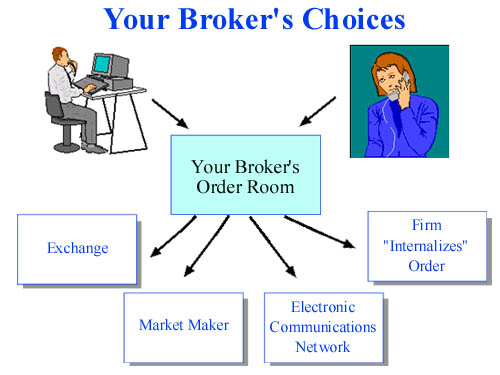
Trade Execution:
What Every Investor Should Know
When you place an order to buy or sell stock, you might not think about where or how your broker will execute the trade. But where and how your order is executed can impact the overall costs of the transaction, including the price you pay for the stock. Here's what you should know about trade execution:
Trade Execution Isn’t Instantaneous
Many investors who trade through online brokerage accounts assume they have a direct connection to the securities markets. But they don't. When you push that enter key, your order is sent over the Internet to your broker—who in turn decides which market to send it to for execution. A similar process occurs when you call your broker to place a trade.
While trade execution is usually seamless and quick, it does take time. And prices can change quickly, especially in fast-moving markets. Because price quotes are only for a specific number of shares, investors may not always receive the price they saw on their screen or the price their broker quoted over the phone. By the time your order reaches the market, the price of the stock could be slightly – or very – different.
No SEC regulations require a trade to be executed within a set period of time. But if firms advertise their speed of execution, they must not exaggerate or fail to tell investors about the possibility of significant delays.
Your Broker Has Options for Executing Your Trade
Just as you have a choice of brokers, your broker generally has a choice of markets to execute your trade:
* For a stock that is listed on an exchange, such as the New York Stock Exchange (NYSE), your broker may direct the order to that exchange, to another exchange (such as a regional exchange), or to a firm called a "third market maker." A "third market maker" is a firm that stands ready to buy or sell a stock listed on an exchange at publicly quoted prices. As a way to attract orders from brokers, some regional exchanges or third market makers will pay your broker for routing your order to that exchange or market maker—perhaps a penny or more per share for your order. This is called "payment for order flow."
* For a stock that trades in an over-the-counter (OTC) market, such as the Nasdaq, your broker may send the order to a "Nasdaq market maker" in the stock. Many Nasdaq market makers also pay brokers for order flow.
* Your broker may route your order – especially a "limit order" – to an electronic communications network (ECN) that automatically matches buy and sell orders at specified prices. A "limit order" is an order to buy or sell a stock at a specific price.
* Your broker may decide to send your order to another division of your broker's firm to be filled out of the firm's own inventory. This is called "internalization." In this way, your broker's firm may make money on the "spread" – which is the difference between the purchase price and the sale price.
Trade Execution Isn’t Instantaneous
Trade Execution Isn’t Instantaneous
Many investors who trade through online brokerage accounts assume they have a direct connection to the securities markets. But they don't. When you push that enter key, your order is sent over the Internet to your broker—who in turn decides which market to send it to for execution. A similar process occurs when you call your broker to place a trade.
While trade execution is usually seamless and quick, it does take time. And prices can change quickly, especially in fast-moving markets. Because price quotes are only for a specific number of shares, investors may not always receive the price they saw on their screen or the price their broker quoted over the phone. By the time your order reaches the market, the price of the stock could be slightly – or very – different.
No SEC regulations require a trade to be executed within a set period of time. But if firms advertise their speed of execution, they must not exaggerate or fail to tell investors about the possibility of significant delays.
Many investors who trade through online brokerage accounts assume they have a direct connection to the securities markets. But they don't. When you push that enter key, your order is sent over the Internet to your broker—who in turn decides which market to send it to for execution. A similar process occurs when you call your broker to place a trade.
While trade execution is usually seamless and quick, it does take time. And prices can change quickly, especially in fast-moving markets. Because price quotes are only for a specific number of shares, investors may not always receive the price they saw on their screen or the price their broker quoted over the phone. By the time your order reaches the market, the price of the stock could be slightly – or very – different.
No SEC regulations require a trade to be executed within a set period of time. But if firms advertise their speed of execution, they must not exaggerate or fail to tell investors about the possibility of significant delays.
Trade Execution: what every investor should know
Trade Execution:
What Every Investor Should Know
When you place an order to buy or sell stock, you might not think about where or how your broker will execute the trade. But where and how your order is executed can impact the overall costs of the transaction, including the price you pay for the stock. Here's what you should know about trade execution:
What Every Investor Should Know
When you place an order to buy or sell stock, you might not think about where or how your broker will execute the trade. But where and how your order is executed can impact the overall costs of the transaction, including the price you pay for the stock. Here's what you should know about trade execution:
Day Trading: your dollar at risk
Day Trading:
Your Dollars at Risk
Day traders rapidly buy and sell stocks throughout the day in the hope that their stocks will continue climbing or falling in value for the seconds to minutes they own the stock, allowing them to lock in quick profits. Day traders usually buy on borrowed money, hoping that they will reap higher profits through leverage, but running the risk of higher losses too.
While day trading is neither illegal nor is it unethical, it can be highly risky. Most individual investors do not have the wealth, the time, or the temperament to make money and to sustain the devastating losses that day trading can bring.
Here are some of the facts that every investor should know about day trading:
*
Be prepared to suffer severe financial losses
Day traders typically suffer severe financial losses in their first months of trading, and many never graduate to profit-making status. Given these outcomes, it's clear: day traders should only risk money they can afford to lose. They should never use money they will need for daily living expenses, retirement, take out a second mortgage, or use their student loan money for day trading.
*
Day traders do not "invest"
Day traders sit in front of computer screens and look for a stock that is either moving up or down in value. They want to ride the momentum of the stock and get out of the stock before it changes course. They do not know for certain how the stock will move, they are hoping that it will move in one direction, either up or down in value. True day traders do not own any stocks overnight because of the extreme risk that prices will change radically from one day to the next, leading to large losses.
*
Day trading is an extremely stressful and expensive full-time job
Day traders must watch the market continuously during the day at their computer terminals. It's extremely difficult and demands great concentration to watch dozens of ticker quotes and price fluctuations to spot market trends. Day traders also have high expenses, paying their firms large amounts in commissions, for training, and for computers. Any day trader should know up front how much they need to make to cover expenses and break even.
*
Day traders depend heavily on borrowing money or buying stocks on margin
Borrowing money to trade in stocks is always a risky business. Day trading strategies demand using the leverage of borrowed money to make profits. This is why many day traders lose all their money and may end up in debt as well. Day traders should understand how margin works, how much time they'll have to meet a margin call, and the potential for getting in over their heads.
*
Don't believe claims of easy profits
Don't believe advertising claims that promise quick and sure profits from day trading. Before you start trading with a firm, make sure you know how many clients have lost money and how many have made profits. If the firm does not know, or will not tell you, think twice about the risks you take in the face of ignorance.
*
Watch out for "hot tips" and "expert advice" from newsletters and websites catering to day traders
Some websites have sought to profit from day traders by offering them hot tips and stock picks for a fee. Once again, don't believe any claims that trumpet the easy profits of day trading. Check out these sources thoroughly and ask them if they have been paid to make their recommendations.
*
Remember that "educational" seminars, classes, and books about day trading may not be objective
Find out whether a seminar speaker, an instructor teaching a class, or an author of a publication about day trading stands to profit if you start day trading.
*
Check out day trading firms with your state securities regulator
Like all broker-dealers, day trading firms must register with the SEC and the states in which they do business. Confirm registration by calling your state securities regulator and at the same time ask if the firm has a record of problems with regulators or their customers. You can find the telephone number for your state securities regulator in the government section of your phone book or by calling the North American Securities Administrators Association at (202) 737-0900. NASAA also provides this information on its website at www.nasaa.org/QuickLinks/ContactYourRegulator.cfm.
Your Dollars at Risk
Day traders rapidly buy and sell stocks throughout the day in the hope that their stocks will continue climbing or falling in value for the seconds to minutes they own the stock, allowing them to lock in quick profits. Day traders usually buy on borrowed money, hoping that they will reap higher profits through leverage, but running the risk of higher losses too.
While day trading is neither illegal nor is it unethical, it can be highly risky. Most individual investors do not have the wealth, the time, or the temperament to make money and to sustain the devastating losses that day trading can bring.
Here are some of the facts that every investor should know about day trading:
*
Be prepared to suffer severe financial losses
Day traders typically suffer severe financial losses in their first months of trading, and many never graduate to profit-making status. Given these outcomes, it's clear: day traders should only risk money they can afford to lose. They should never use money they will need for daily living expenses, retirement, take out a second mortgage, or use their student loan money for day trading.
*
Day traders do not "invest"
Day traders sit in front of computer screens and look for a stock that is either moving up or down in value. They want to ride the momentum of the stock and get out of the stock before it changes course. They do not know for certain how the stock will move, they are hoping that it will move in one direction, either up or down in value. True day traders do not own any stocks overnight because of the extreme risk that prices will change radically from one day to the next, leading to large losses.
*
Day trading is an extremely stressful and expensive full-time job
Day traders must watch the market continuously during the day at their computer terminals. It's extremely difficult and demands great concentration to watch dozens of ticker quotes and price fluctuations to spot market trends. Day traders also have high expenses, paying their firms large amounts in commissions, for training, and for computers. Any day trader should know up front how much they need to make to cover expenses and break even.
*
Day traders depend heavily on borrowing money or buying stocks on margin
Borrowing money to trade in stocks is always a risky business. Day trading strategies demand using the leverage of borrowed money to make profits. This is why many day traders lose all their money and may end up in debt as well. Day traders should understand how margin works, how much time they'll have to meet a margin call, and the potential for getting in over their heads.
*
Don't believe claims of easy profits
Don't believe advertising claims that promise quick and sure profits from day trading. Before you start trading with a firm, make sure you know how many clients have lost money and how many have made profits. If the firm does not know, or will not tell you, think twice about the risks you take in the face of ignorance.
*
Watch out for "hot tips" and "expert advice" from newsletters and websites catering to day traders
Some websites have sought to profit from day traders by offering them hot tips and stock picks for a fee. Once again, don't believe any claims that trumpet the easy profits of day trading. Check out these sources thoroughly and ask them if they have been paid to make their recommendations.
*
Remember that "educational" seminars, classes, and books about day trading may not be objective
Find out whether a seminar speaker, an instructor teaching a class, or an author of a publication about day trading stands to profit if you start day trading.
*
Check out day trading firms with your state securities regulator
Like all broker-dealers, day trading firms must register with the SEC and the states in which they do business. Confirm registration by calling your state securities regulator and at the same time ask if the firm has a record of problems with regulators or their customers. You can find the telephone number for your state securities regulator in the government section of your phone book or by calling the North American Securities Administrators Association at (202) 737-0900. NASAA also provides this information on its website at www.nasaa.org/QuickLinks/ContactYourRegulator.cfm.
Day Trading
Day Trading
Day traders rapidly buy and sell stocks throughout the day in the hope that their stocks will continue climbing or falling in value for the seconds to minutes they own the stock, allowing them to lock in quick profits. Day trading is extremely risky and can result in substantial financial losses in a very short period of time. If you are a day trader, or are thinking about day trading, read our publication, Day Trading: Your Dollars at Risk. We also have warnings and tips about online trading and day trading.
Under the rules of NYSE and NASD, customers who are deemed "pattern day traders" must have at least $25,000 in their accounts and can only trade in margin accounts. For more information, you can read the NASD's Notice to Members and the New York Stock Exchange's Information Memo.
The Connecticut Council on Problem Gambling has a quiz to help you decide if you are gambling in our markets and where to go for help.
Day traders rapidly buy and sell stocks throughout the day in the hope that their stocks will continue climbing or falling in value for the seconds to minutes they own the stock, allowing them to lock in quick profits. Day trading is extremely risky and can result in substantial financial losses in a very short period of time. If you are a day trader, or are thinking about day trading, read our publication, Day Trading: Your Dollars at Risk. We also have warnings and tips about online trading and day trading.
Under the rules of NYSE and NASD, customers who are deemed "pattern day traders" must have at least $25,000 in their accounts and can only trade in margin accounts. For more information, you can read the NASD's Notice to Members and the New York Stock Exchange's Information Memo.
The Connecticut Council on Problem Gambling has a quiz to help you decide if you are gambling in our markets and where to go for help.
Turtle Trading Explained
One popular trading style that keeps on coming back from the dead with the regularity of the baddie in a horror flick is 'Turtle Trading'. A swing trading style, the Turtle Trading system was devised by legendary trader Richard Dennis in order to show that great traders weren't born, they could be 'grown', just like turtles in a Far East Turtle farm.
There are many websites offering courses in how to turtle trade, sometimes for thousands of dollars, some of them even run by people who are allegedly 'ex-turtles'. This is frankly hilarious - the entire turtle system is available for free as a PDF download from www.originalTurtles.org and we here at www.traders101.com STRONGLY advise you to grab it and read it before you lash out any cash on a 'course'. As far as we know, there is NOTHING to be learned from these expensive 'courses' that you can't find for free in the excellent download, written by real Turtle traders who were trained by the great man himself.
In order to help you decide whether turtle trading is for you, here's a quick overview. First off, in 1983 when Dennis tried the scheme, it worked. It worked BIG TIME in fact, producing an AVERAGE 80% compounded over the four years of the trial. The turtle trading rules themselves were simple - the secret was the ability to STICK TO THE RULES!. This made it a mechanical trading system par excellence, and a good mechanical trading system, as you should know, is the key to consistency.
The turtle trading rules specified in detail what markets to trade, how to size a position properly, when to enter and exit, how to use stops to exit a losing position, how to exit a winning position, and some ancillary tactics on the buying and selling of large positions without alerting the market.
What to trade. The turtles traded futures (commodities, as they were known at the time). They traded all liquid futures markets except grains and meats. That included T Bonds, coffee, sugar, cotton, currencies, precious metals and oils. An individual trader could decide what he wanted to trade.
Position Sizing. The turtles liked to normalize their positions based on the underlying dollar volatility of the market - a common trick nowadays, but advanced for the 80s. This made the effective risk across markets similar, and allowed them to trade many markets in a similar way. Key to this is 'N' - the underlying volatility of a market. To calculate N, find the 20 day exponential MA of the ATR (true range). There's a lot on Moving Averages over at www.traders101.com if you need a refresher. Having found N, the 'Dollar Volatility' is N x Dollars Per point. The S&P, for example, moves 50 bucks a point on the emini contract.
To create a turtle trading 'unit', you work out 1% of your equity, and divide by the dollar volatility. As you might have guessed, its a low risk strategy, as you need to be able to withstand extended drawdown periods to 'stay in the game'. The 'unit' tells you how many contracts to trade, and still stay relatively safe. To further de-risk the system, each market had limits. No more than 4 units could be traded in a single market, for example.
After losing trades, turtles would reduce the effective equity, in order to scale back risk even further. Expand when you are winning, pull back when you are losing. But how did they know when to trade???
Entries. There were 2 breakout systems used by the turtles. The first used a 20 day breakout. The second used a 55 day breakout. A 20 day breakout is where the high or low exceeds the high or low of the preceding 20 days. They took the trade when it was offered - i.e. this was not an 'end of day' system. If an opening gap caused the breakout, the turtles would still take the trade, as the idea was they would be in it for some days, and a couple of points at the start didn't matter. Personally, (and everyone at www.traders101.com agrees!) we never chase the gap. Obviously, the turtles traded both long and short. There were a couple of extra rules, such as ignoring a signal if the LAST breakout (whether the turtle took it or not) would have led to a winner. The 55 day breakout would then become the initiation point as a fail-safe on major moves. Full rules, are of course, available in the free download.
Stops. Turtle traders ALWAYS used stops. They defined the exit point BEFORE initiating a trade. Their positions could be so large that in order NOT to alert the market, 'mental' stops were used. No trade could carry more than 2% risk. This means a stop would be 2 x N away from the position.
Exits. Most breakouts do NOT result in trends. Most turtle trades, therefore, ended in losses. The winners therefore had to be BIG to cover the losers, and they were. The first exit rule was to exit on a 10 day low or high against your position. The second method was an exit against a 20 day high or low. Simple, yes. But at the time it worked. The HARD part for most traders is hanging on grimly as profits evaporate over 10 or 20 days! The cultivation of THAT discipline was the real secret!
Does it still work? Sometimes. The market is well aware of the legions of would-be turtles avidly watching for 20 day breakouts. 'Turtle Soup' is a common maneuver whereby a big player 'fakes' a move up or down to trigger the turtle signals, then reverses it, stopping them out. Mean, ain't it? Bottom line, if you want to turtle trade, you need to adapt the rules for your own personal style and hide your 'footprint' in the market.
About the Author
Trader Jack writes stock trading artices for www.traders101.com the free site helping traders get into profit fast
There are many websites offering courses in how to turtle trade, sometimes for thousands of dollars, some of them even run by people who are allegedly 'ex-turtles'. This is frankly hilarious - the entire turtle system is available for free as a PDF download from www.originalTurtles.org and we here at www.traders101.com STRONGLY advise you to grab it and read it before you lash out any cash on a 'course'. As far as we know, there is NOTHING to be learned from these expensive 'courses' that you can't find for free in the excellent download, written by real Turtle traders who were trained by the great man himself.
In order to help you decide whether turtle trading is for you, here's a quick overview. First off, in 1983 when Dennis tried the scheme, it worked. It worked BIG TIME in fact, producing an AVERAGE 80% compounded over the four years of the trial. The turtle trading rules themselves were simple - the secret was the ability to STICK TO THE RULES!. This made it a mechanical trading system par excellence, and a good mechanical trading system, as you should know, is the key to consistency.
The turtle trading rules specified in detail what markets to trade, how to size a position properly, when to enter and exit, how to use stops to exit a losing position, how to exit a winning position, and some ancillary tactics on the buying and selling of large positions without alerting the market.
What to trade. The turtles traded futures (commodities, as they were known at the time). They traded all liquid futures markets except grains and meats. That included T Bonds, coffee, sugar, cotton, currencies, precious metals and oils. An individual trader could decide what he wanted to trade.
Position Sizing. The turtles liked to normalize their positions based on the underlying dollar volatility of the market - a common trick nowadays, but advanced for the 80s. This made the effective risk across markets similar, and allowed them to trade many markets in a similar way. Key to this is 'N' - the underlying volatility of a market. To calculate N, find the 20 day exponential MA of the ATR (true range). There's a lot on Moving Averages over at www.traders101.com if you need a refresher. Having found N, the 'Dollar Volatility' is N x Dollars Per point. The S&P, for example, moves 50 bucks a point on the emini contract.
To create a turtle trading 'unit', you work out 1% of your equity, and divide by the dollar volatility. As you might have guessed, its a low risk strategy, as you need to be able to withstand extended drawdown periods to 'stay in the game'. The 'unit' tells you how many contracts to trade, and still stay relatively safe. To further de-risk the system, each market had limits. No more than 4 units could be traded in a single market, for example.
After losing trades, turtles would reduce the effective equity, in order to scale back risk even further. Expand when you are winning, pull back when you are losing. But how did they know when to trade???
Entries. There were 2 breakout systems used by the turtles. The first used a 20 day breakout. The second used a 55 day breakout. A 20 day breakout is where the high or low exceeds the high or low of the preceding 20 days. They took the trade when it was offered - i.e. this was not an 'end of day' system. If an opening gap caused the breakout, the turtles would still take the trade, as the idea was they would be in it for some days, and a couple of points at the start didn't matter. Personally, (and everyone at www.traders101.com agrees!) we never chase the gap. Obviously, the turtles traded both long and short. There were a couple of extra rules, such as ignoring a signal if the LAST breakout (whether the turtle took it or not) would have led to a winner. The 55 day breakout would then become the initiation point as a fail-safe on major moves. Full rules, are of course, available in the free download.
Stops. Turtle traders ALWAYS used stops. They defined the exit point BEFORE initiating a trade. Their positions could be so large that in order NOT to alert the market, 'mental' stops were used. No trade could carry more than 2% risk. This means a stop would be 2 x N away from the position.
Exits. Most breakouts do NOT result in trends. Most turtle trades, therefore, ended in losses. The winners therefore had to be BIG to cover the losers, and they were. The first exit rule was to exit on a 10 day low or high against your position. The second method was an exit against a 20 day high or low. Simple, yes. But at the time it worked. The HARD part for most traders is hanging on grimly as profits evaporate over 10 or 20 days! The cultivation of THAT discipline was the real secret!
Does it still work? Sometimes. The market is well aware of the legions of would-be turtles avidly watching for 20 day breakouts. 'Turtle Soup' is a common maneuver whereby a big player 'fakes' a move up or down to trigger the turtle signals, then reverses it, stopping them out. Mean, ain't it? Bottom line, if you want to turtle trade, you need to adapt the rules for your own personal style and hide your 'footprint' in the market.
About the Author
Trader Jack writes stock trading artices for www.traders101.com the free site helping traders get into profit fast
Monday, March 13, 2006
ETF Pros
ETF Pros
bullet Some ETFs may have lower expense ratios than similar conventional index mutual funds. If true, this suggests that ongoing management fees would be lower, which favors ETFs. However, note that most ETFs have expense ratios which are not dramatically lower than the lowest cost conventional index mutual funds with similar investment goals.
bullet ETFs may be somewhat more tax efficient than similar conventional index mutual funds. This increased tax-efficiency is in the form of lower capital gains distributions (which effectively means that an ETF's capital gains tend to be more deferred than a similar mutual fund's would be). The idea that ETFs should have lower capital gains distributions comes from their ability to shed their lowest-basis shares to institutional arbitrageurs through in-kind redemptions. Note that this benefit applies to a much lesser extent to Vanguard's VIPER ETFs. Because they exist as a separate share class of conventional mutual funds, any tax benefit a VIPER ETF generates is shared by investors in the fund's non-ETF shares, thus diluting the beneficial effect for VIPER share owners.
bullet ETFs may have somewhat less "cash drag" than similar conventional mutual funds. Conventional mutual funds typically need to maintain a small amount of their portfolio in cash in order to meet ongoing cash redemptions. An ETF has no such need because it never has to deal with the possibility of cash redemptions. This may provide a slight advantage for ETFs over similar index mutual funds.
Note that if the ETF you are considering has a higher expense ratio than any similar conventional no-load index mutual fund AND the prospective ETF investment would not be in a taxable account (e.g., you are in an IRA), then ETFs will almost certainly underperform the alternative and you should abandon the idea of using the ETF in favor of the alternative.
bullet Some ETFs may have lower expense ratios than similar conventional index mutual funds. If true, this suggests that ongoing management fees would be lower, which favors ETFs. However, note that most ETFs have expense ratios which are not dramatically lower than the lowest cost conventional index mutual funds with similar investment goals.
bullet ETFs may be somewhat more tax efficient than similar conventional index mutual funds. This increased tax-efficiency is in the form of lower capital gains distributions (which effectively means that an ETF's capital gains tend to be more deferred than a similar mutual fund's would be). The idea that ETFs should have lower capital gains distributions comes from their ability to shed their lowest-basis shares to institutional arbitrageurs through in-kind redemptions. Note that this benefit applies to a much lesser extent to Vanguard's VIPER ETFs. Because they exist as a separate share class of conventional mutual funds, any tax benefit a VIPER ETF generates is shared by investors in the fund's non-ETF shares, thus diluting the beneficial effect for VIPER share owners.
bullet ETFs may have somewhat less "cash drag" than similar conventional mutual funds. Conventional mutual funds typically need to maintain a small amount of their portfolio in cash in order to meet ongoing cash redemptions. An ETF has no such need because it never has to deal with the possibility of cash redemptions. This may provide a slight advantage for ETFs over similar index mutual funds.
Note that if the ETF you are considering has a higher expense ratio than any similar conventional no-load index mutual fund AND the prospective ETF investment would not be in a taxable account (e.g., you are in an IRA), then ETFs will almost certainly underperform the alternative and you should abandon the idea of using the ETF in favor of the alternative.
Friday, March 10, 2006
ETF Cons vs. index mutual funds
This is the new question etf, etf investing, etf portfolios
ETF Cons...remember this is all etf cons vs. index mutual funds.
bullet When you buy or sell an ETF, you implicitly pay (as a "hidden" fee) one-half of the ETF's "bid-ask spread." Bid-ask spread is the difference in price between the market price for buying the ETF and the market price for selling the ETF. Note that, for a conventional no-load mutual fund, there is no bid-ask spread involved.
An ETF's bid-ask spread can be quite small (e.g., for domestic large-cap stock ETFs and Treasury Bond ETFs) or quite large (e.g., for emerging market ETFs). In our opinion, this is the factor which most makes it impractical to utilize ETFs. Bid-ask spreads make it impractical to hold ETFs for very short lengths of time (i.e., because it probably doesn't make sense to incur this implicit purchase/redemption fee very often).
However, even if an ETF has a large bid-ask spread, it is conceptually possible for it to outperform a similar conventional index mutual fund in the long run if (and only if) both of the following are true:
bullet The ETF has a lower expense ratio than the similar conventional index mutual fund.
bullet The ETF will be held long enough for the compounded benefit of the lower expense ratio to exceed the higher costs of the bid-ask spread.
bullet In order to buy or sell an ETF, you need to pay a brokerage commission. If you buy/sell through a discount broker, this might be on order of $10/trade (no such fees are typically needed to buy/sell a no-load mutual fund). This fact makes dollar-cost averaging small amounts into ETFs impractical. ETFs are most practical for deploying relatively large amounts of capital.
bullet The ETF may have somewhat higher internal transaction costs than a similar conventional index mutual fund. When the index that the ETF tracks changes, it must sell all shares of stocks leaving the index and buy enough shares of stocks entering the index. In order to buy enough of the replacement stock, it may need to sell shares of hundreds of other stocks — incurring significant trading expenses.
A conventional index mutual fund must also sell all shares of stocks leaving the index and buy shares of the replacement. However, it can do it as part of its ongoing cash-flow management process. If, for example, the fund has net purchases (i.e., net cash-flow into the fund), it has to buy some stocks with that money anyway — and this cash can be used to buy the new index component. Likewise, if the fund is experiencing net redemptions, it has to sell stocks anyway — and it can choose to generate liquidity by selling shares of the stock which left the index.
Note that this criticism does NOT apply to Vanguard's VIPER ETFs. They exist as separate share classes of conventional index mutual funds and are not subject to this adverse effect.
bullet ETFs won't track indexes as well as conventional index mutual funds. A mutual fund's share price is always, by definition, the fund's net asset value (NAV). The NAV is just the weighted-average current market value of all the fund's holdings, expressed on a per-share basis.
An ETF, on the other hand, is valued by the market. So even if its holdings are EXACTLY consistent with those of the index, its market price at any particular time can be either above or below the NAV (meaning it can be sold at either a higher or lower price than the per-share value of its underlying securities).
The difference between NAV and market price for an ETF won't ever be very high because institutional arbitrageurs are able to either create or redeem shares of the ETF using the underlying stocks. This tends to drive the ETF price back towards its NAV. However, this tracking error is likely to be higher for ETFs which hold less liquid securities (e.g., emerging markets stocks).
bullet ETFs have poor coverage of foreign style/size indexes. If you wanted to buy a foreign value ETF, for example, you would not be able to do so at present. There is a much greater selection of non-ETF foreign mutual funds covering the gamut of style and size combinations.
bullet There are few bond ETF options available at present. However, note that ETFs are less desirable for bonds anyway — since a relatively small portion of a bond's total return is due to capital gains, the tax efficiency benefit of bond ETFs is relatively trivial.
bullet If the ETF is organized as a Unit Investment Trust (e.g., the SPDR ETFs), then all dividends the fund receives are required to be held in a non-interest bearing account until distributed to investors. This causes a "cash-drag" on the fund's earnings which conventional index mutual funds (and non-UIT ETFs) don't experience.
bullet Most people choose to have distributions of conventional mutual funds automatically reinvested in additional shares of the fund. This is convenient — it keeps your money working for you without requiring extra effort on your part to redeploy the distributions.
On the other hand, ETFs don't have this as an alternative. They pay out distributions as cash. If you want to then reinvest that cash, you need to take some action to do so (and incur whatever transaction costs apply).
bullet Apparently, you can only buy/sell ETFs in whole share lots. In other words, while you can buy exactly $5,849.23 of some mutual fund, you can't necessarily buy that much in an ETF — you have to buy whole shares (not fractional shares). This isn't a big deal, you just have a bit less flexibility and there may be a little more "cash-drag" in your account if you use ETFs instead of mutual funds. But then again, ETFs tend to hold lesser amounts of cash themselves (since they don't have to keep cash on hand to meet cash redemptions, as do mutual funds).
Overall, there are few pros and many cons to using ETFs. However, for certain situations, there are low-cost ETFs which may make sense.
especial thanks to Altruist Financial Advisors LLC
ETF Cons...remember this is all etf cons vs. index mutual funds.
bullet When you buy or sell an ETF, you implicitly pay (as a "hidden" fee) one-half of the ETF's "bid-ask spread." Bid-ask spread is the difference in price between the market price for buying the ETF and the market price for selling the ETF. Note that, for a conventional no-load mutual fund, there is no bid-ask spread involved.
An ETF's bid-ask spread can be quite small (e.g., for domestic large-cap stock ETFs and Treasury Bond ETFs) or quite large (e.g., for emerging market ETFs). In our opinion, this is the factor which most makes it impractical to utilize ETFs. Bid-ask spreads make it impractical to hold ETFs for very short lengths of time (i.e., because it probably doesn't make sense to incur this implicit purchase/redemption fee very often).
However, even if an ETF has a large bid-ask spread, it is conceptually possible for it to outperform a similar conventional index mutual fund in the long run if (and only if) both of the following are true:
bullet The ETF has a lower expense ratio than the similar conventional index mutual fund.
bullet The ETF will be held long enough for the compounded benefit of the lower expense ratio to exceed the higher costs of the bid-ask spread.
bullet In order to buy or sell an ETF, you need to pay a brokerage commission. If you buy/sell through a discount broker, this might be on order of $10/trade (no such fees are typically needed to buy/sell a no-load mutual fund). This fact makes dollar-cost averaging small amounts into ETFs impractical. ETFs are most practical for deploying relatively large amounts of capital.
bullet The ETF may have somewhat higher internal transaction costs than a similar conventional index mutual fund. When the index that the ETF tracks changes, it must sell all shares of stocks leaving the index and buy enough shares of stocks entering the index. In order to buy enough of the replacement stock, it may need to sell shares of hundreds of other stocks — incurring significant trading expenses.
A conventional index mutual fund must also sell all shares of stocks leaving the index and buy shares of the replacement. However, it can do it as part of its ongoing cash-flow management process. If, for example, the fund has net purchases (i.e., net cash-flow into the fund), it has to buy some stocks with that money anyway — and this cash can be used to buy the new index component. Likewise, if the fund is experiencing net redemptions, it has to sell stocks anyway — and it can choose to generate liquidity by selling shares of the stock which left the index.
Note that this criticism does NOT apply to Vanguard's VIPER ETFs. They exist as separate share classes of conventional index mutual funds and are not subject to this adverse effect.
bullet ETFs won't track indexes as well as conventional index mutual funds. A mutual fund's share price is always, by definition, the fund's net asset value (NAV). The NAV is just the weighted-average current market value of all the fund's holdings, expressed on a per-share basis.
An ETF, on the other hand, is valued by the market. So even if its holdings are EXACTLY consistent with those of the index, its market price at any particular time can be either above or below the NAV (meaning it can be sold at either a higher or lower price than the per-share value of its underlying securities).
The difference between NAV and market price for an ETF won't ever be very high because institutional arbitrageurs are able to either create or redeem shares of the ETF using the underlying stocks. This tends to drive the ETF price back towards its NAV. However, this tracking error is likely to be higher for ETFs which hold less liquid securities (e.g., emerging markets stocks).
bullet ETFs have poor coverage of foreign style/size indexes. If you wanted to buy a foreign value ETF, for example, you would not be able to do so at present. There is a much greater selection of non-ETF foreign mutual funds covering the gamut of style and size combinations.
bullet There are few bond ETF options available at present. However, note that ETFs are less desirable for bonds anyway — since a relatively small portion of a bond's total return is due to capital gains, the tax efficiency benefit of bond ETFs is relatively trivial.
bullet If the ETF is organized as a Unit Investment Trust (e.g., the SPDR ETFs), then all dividends the fund receives are required to be held in a non-interest bearing account until distributed to investors. This causes a "cash-drag" on the fund's earnings which conventional index mutual funds (and non-UIT ETFs) don't experience.
bullet Most people choose to have distributions of conventional mutual funds automatically reinvested in additional shares of the fund. This is convenient — it keeps your money working for you without requiring extra effort on your part to redeploy the distributions.
On the other hand, ETFs don't have this as an alternative. They pay out distributions as cash. If you want to then reinvest that cash, you need to take some action to do so (and incur whatever transaction costs apply).
bullet Apparently, you can only buy/sell ETFs in whole share lots. In other words, while you can buy exactly $5,849.23 of some mutual fund, you can't necessarily buy that much in an ETF — you have to buy whole shares (not fractional shares). This isn't a big deal, you just have a bit less flexibility and there may be a little more "cash-drag" in your account if you use ETFs instead of mutual funds. But then again, ETFs tend to hold lesser amounts of cash themselves (since they don't have to keep cash on hand to meet cash redemptions, as do mutual funds).
Overall, there are few pros and many cons to using ETFs. However, for certain situations, there are low-cost ETFs which may make sense.
especial thanks to Altruist Financial Advisors LLC
Thursday, March 09, 2006
This is the new question etf, etf investing, etf portfolios
This is the new question etf, etf investing, etf portfolios? What should you do when it comes to etf, etf investing, or even etf portfolio. Well, we are going to be coming up with some etf, etf investing, and etf portfolios pro and cons serious. Please be looking out for these. That's right an etf, etf investing, and etf portfolios pro and cons serious!!
Exchange Traded Funds (etf) have recently become somewhat popular. What are etf, etf investing...well to be simple, they are basically just index mutual funds which are bought and sold as stocks. In that way, they are similar to closed-end mutual funds which happen to be index funds. However, they have several interesting features which make them more similar to conventional (open-end) index mutual funds.
An obvious question is, "Which should I use, etf investing or conventional index mutual funds?"
We have it all here yet to come etf, etf investing, and etf portfolios pro and cons serious coming soon!!!
Exchange Traded Funds (etf) have recently become somewhat popular. What are etf, etf investing...well to be simple, they are basically just index mutual funds which are bought and sold as stocks. In that way, they are similar to closed-end mutual funds which happen to be index funds. However, they have several interesting features which make them more similar to conventional (open-end) index mutual funds.
An obvious question is, "Which should I use, etf investing or conventional index mutual funds?"
We have it all here yet to come etf, etf investing, and etf portfolios pro and cons serious coming soon!!!
Friday, March 03, 2006
How to Maximize Your 401k Mutual Fund Returns
How to Maximize Your 401k Mutual Fund Returns
By: Ulli G. Niemann
When it comes to 401k's there is an overabundance of sad stories. Here is one that at least has a happy ending—and it's getting happier all the time.
Last year (in 2002) a friend of mine—let’s call him Jack—phoned and asked if I could help him with his 401k. Jack works for a large company as Senior VP of lending and is financially pretty astute. However, when it came to his 401k mutual fund decisions, he had repeatedly made the same mistake most people were making. As a result, he saw his account drop in value substantially.
At the time we were in the midst of the 2000 bear market, which showed no sign of letting up. Jack had purchased into a Lifestyle fund because someone recommended it. By the time he finally bailed out, it cost him dearly. However, he continued to make the same mistake by reinvesting.
He checked with the 401k representative and subsequently switched to a variety of mutual funds ranging from World Stock to Domestic Hybrids, Large and Small Value as well as Growth. But nothing worked and his portfolio value headed further south.
By the time we met to discuss his 401k Jack was pretty disgusted by the canned advice he had received and the continued losses he was sustaining.
Jack knew that I had pretty much eluded the bear market of 2000 by having sold all of my clients’ positions on 10/13/2000. We were safely in our money market accounts weathering out the storm (see my article "How we eluded the bear in 2000."
Thinking about this, Jack could only shake his head because at no point in the market slide had he ever been given what I believe was the right advice. That is, no one suggested that, since we were in a bear market, he might want to step aside and remain in the safety of his money market account. So he stayed invested, hoping against the evidence all around him to find something that was not crashing. That was his mistake, and one shared by many.
The advice that he consistently and continually received was that the market was close to a bottom, stocks “have to” move up from these levels, and, my personal money losing favorite, “the market can’t go any lower.” That's what people wanted to hear and believe. But my tracking system said otherwise, and I followed its indicators—much to the delight of my clients.
Jack wanted to know how I could help. Looking at his mutual fund choices I realized that they were actually pretty decent, and he had a variety of some 13 funds. So, what was the problem and how could we solve it? In a way, the answer was simple. But people were having to get pretty beat up before they would see it.
My first step was, with Jack's permission, to log on to his 401k web site. Then I started making some adjustments. Since my trend tracking model was still in a Sell mode, I liquidated all of his positions and moved the proceeds into money market. This accomplished one thing right away: He stopped losing money. When you stop moving backward, in relation to everyone else you are moving forward!
Second, as my trend index moved into a Buy mode on April 29, 2003, I researched his funds again. Based on strong momentum figures, I invested in two of his mutual fund choices. The result was very gratifying: the funds I chose moved up around 10% in the two months after my Buy. (Other funds I had tracked and selected for other types of investment programs moved up as much as 26% in that period.)
Jack’s been happy ever since. While the 10% appreciation is not as great as I was able to do with assets outside his 401k, it still confirms that the key to successful investing is methodology and discipline. Our disciplined approach relies on objective information. It disregards Wall Street hype designed to perpetuate commission-rich buy now while it's low, or buy and hold strategies.
If you have been in a situation similar to Jack's, or you want to avoid being in one, find an investment advisor who bases his decisions on a measured and objective approach. That will give you the edge no matter whether the market is going up or down and will give you the greatest protection from sad stories with your 401k.
About the Author
Ulli Niemann is an investment advisor and has been writing about objective, methodical approaches to investing for over 10 years. He eluded the bear market of 2000 and has helped hundreds of people make better investment decisions. To find out more about his approach and his FREE Newsletter, please visit: www.successful-investment.com.Please also check out forextradingindex.com
Thursday, February 09, 2006
Savings 101: tax-free 529 college savings accounts may not stay that way, but they'll still be a smart way to plan for your child's future
SO-CALLED 529 college savings accounts--inelegantly named for the section of tax code that gave them life--have been attracting parents of school-age kids since the code was enacted in 1996. The accounts grow tax-deferred, and withdrawals used for qualified higher education expenses became tax-free in 2002. The investing public has taken notice--last year, assets in the plans soared 49 percent to $52.3 billion and rose another 6 percent in the first quarter of this year, reaching $55.4 billion.
"I always thought 529s were a good deal, [even] before they became totally tax-free," says Joe Hurley, founder and CEO of Savingforcollege.com LLC. Now, he says, they're virtually a no-brainer for parents or grandparents who want to set a little something aside for Junior's education.
The law that made 529s tax-free is supposed to phase out at the end of 2010, but if you're worried, don't be. The odds of Congress letting this popular tax-saver expire are close to nil. Sometime in the next five years, legislators are almost certain to make it a permanent part of the code.
In the meantime, consider that tax-deferred college savings accounts would still be a good deal for most of us. Contributions, for example, remain under the control of the donor until used, which means Junior can't take the money and buy a new car. The money is similarly considered part of the donor's assets when it comes to financial aid calculations, which means your student can qualify for more aid. The accounts also offer some helpful estate-planning benefits. And finally, at least half the states offer tax deductions or credits to residents who contribute to in-state plans.
Just remember that not all 529s are created equal. Compare investment options, tax benefits, fees and services of various state plans at Hurley's site, www.savingforcollege.com. It's a free service that rates programs on a scale from one to five, depending on how they fare on various criteria. Many of the best 529 programs are sold directly to investors rather than through a broker, so the more homework you do on your own, the better off you--and Junior--will be.
SCOTT BERNARD NELSON is assistant business editor at The Oregonian and a freelance writer in Portland, Oregon.
COPYRIGHT 2005 Entrepreneur Media, Inc.
COPYRIGHT 2005 Gale Group
Wednesday, February 08, 2006
utility stocks have gone back to basics
In the days before deregulation of the utility industry, electric and gas stocks provided investors with a steady income stream that ranked low on investment stress. That all changed during the hotshot '90s, as many utility companies bought into businesses they knew little or nothing about, like telecommunications or home security. Now the tide has turned, and gas and electric companies are getting back to what they know best--power.
"Many [utilities] went into risky businesses and lost as their share values dropped," says Barry Abramson, coportfolio manager of the Gabelli Utilities Fund (GABUX). "The management that survived learned their lessons, and now many are in better shape with a 'back to the basics' business strategy,"
That stick-to-your-knitting attitude has worked for Abramson and his stock selections in the GABUX portfolio. Up nearly 24 percent year-to-date through November 28, the fund has about 70 stocks in "its portfolio: 5 percent in telecom, 15 percent in gas utilities and 80 percent in electric utilities.
Abramson prefers regulated utility companies. He invests in all sizes of companies and seeks out those that may be ripe for a takeover. But don't expect this five-star Morningstar fund to be a razzle-dazzler. Basic utility companies aren't made that way. For conservative investors, this fund is worth a look.
* Web site: www.gabelli.com
* Toll-free number: (800) 422-3554
DIAN VUJOVICH is an author, syndicated columnist and publisher of fund investing site www.fundfreebies.com.
COPYRIGHT 2004 Entrepreneur Media, Inc.
COPYRIGHT 2004 Gale Group
Tuesday, January 24, 2006
Retirement planning as a do-it-yourself job
Daily Record and the Kansas City Daily News-Press, Dec 19, 2005 by Mike Trask
new
Save a personal copy of this article and quickly find it again with Furl.net. It's free! Save it.
The traditional pension plan appears to be in danger of extinction.
Once prevalent in corporate America, many companies have converted their defined pension plans into 401(k) savings plans while others, like bankrupt United Airlines, have turned them over to the federal government's Pension Benefit Guaranty Corporation, an entity Congress created in 1974 that insures companies' pension plans and is funded by companies' premium payments. Because of a spate of bankruptcies and other factors, the PBGC is now some $23 billion in the red.
The money available to pay benefits is eventually going to run out unless Congress enacts comprehensive pension reform to get plans better funded and provide the insurance program with additional resources, PBGC's Executive Director Bradley Belt said in a written statement last month.
For much of the 20th century people had to be concerned only with staying with their employer long enough to collect a pension benefit that would provide a reasonable standard of living in retirement. Today, most employees today have to take responsibility for providing for their retirement.
The government has made it very clear: Here are 401ks. Save for yourself. Here are Roth IRAs. They will be tax free when you get to retirement, said Bob Blattel, who operates a financial and estate planning firm in St. Peters.
The government is putting a sign out saying, 'If you don't do it yourself, you're screwed.' The government has been telling us this for 20 years . . . and people are not picking up the signals. While savings rates in Japan, Germany, France and other countries are over 10 percent, in this country the rate is under 3 percent, he said.
Blattel said his clients aren't as concerned about retirement savings as they should be. When Social Security began in the 1930s, there were 40 workers for each Social Security recipient. The ratio now is three to one. In addition, people are living much longer today, enjoying 10, 20 or even 30 or more years of retirement, he said.
People aren't recognizing the length of retirement, Blattel said. I don't think they recognize how long they're going to need their money.
Also, people generally don't account for inflation when saving for retirement. For example, the amount a person thinks he might need to live on actually could be double that amount because of the effect of inflation over a 20-year period, he said. That is especially true when it comes to medical costs, he added.
Social Security is relied on by way too many people as being the sole provider of retirement funds, Blattel said. There's talk about Social Security going broke by 2017 unless changes to the system are made, but there's not a politician living that is going to allow it to go bankrupt, he said.
However, Blattel is concerned that Congress will keep raising the age for people to start receiving benefits and do more means testing, or determining Social Security payments based on recipients' income levels.
Part of the problem is that people are spending more than they should. They other part of it is they're not getting the basic education that they need concerning savings and investment, he said. People are fooling themselves if they think they can wait until their children are raised before they start saving for retirement. It can't just happen that quickly, he added.
For all these reasons, employees need to become educated about retirement savings. And they need to get their education and advice from objective sources, he said.
We were at the GM plant [in Wentzville] in 1996 doing a seminar for them when they were shut down, and these workers had no concept in what they were investing in, he said. Blattel said that when he quizzed some of them about their investments, they told him that they invested on the advice of co-workers.
Most employers with 401(k) plans bring in the investment companies overseeing those plans to talk to employees. It's like going to the cow and asking if the milk is good, he said.
Blattel thinks that will change before long. There is a regulation on 401(k) plans that requires companies to provide employees with more objective information about their plans.
I don't think it's going to take long for them to see the light. All we need is an attorney with a class action suit saying, 'My client should have hit $400,000, but he wasn't properly educated. He kept his in a money market for 30 years. I think the company is responsible.' It's coming, he said.
This article was originally published in The Daily Record, St. Louis, Mo., another Dolan Media publication.
Copyright 2005 Dolan Media Newswires
Provided by ProQuest Information and Learning Company. All rights Reserved.
Save a personal copy of this article with Furl.netSave Printer friendly version
new
Save a personal copy of this article and quickly find it again with Furl.net. It's free! Save it.
The traditional pension plan appears to be in danger of extinction.
Once prevalent in corporate America, many companies have converted their defined pension plans into 401(k) savings plans while others, like bankrupt United Airlines, have turned them over to the federal government's Pension Benefit Guaranty Corporation, an entity Congress created in 1974 that insures companies' pension plans and is funded by companies' premium payments. Because of a spate of bankruptcies and other factors, the PBGC is now some $23 billion in the red.
The money available to pay benefits is eventually going to run out unless Congress enacts comprehensive pension reform to get plans better funded and provide the insurance program with additional resources, PBGC's Executive Director Bradley Belt said in a written statement last month.
For much of the 20th century people had to be concerned only with staying with their employer long enough to collect a pension benefit that would provide a reasonable standard of living in retirement. Today, most employees today have to take responsibility for providing for their retirement.
The government has made it very clear: Here are 401ks. Save for yourself. Here are Roth IRAs. They will be tax free when you get to retirement, said Bob Blattel, who operates a financial and estate planning firm in St. Peters.
The government is putting a sign out saying, 'If you don't do it yourself, you're screwed.' The government has been telling us this for 20 years . . . and people are not picking up the signals. While savings rates in Japan, Germany, France and other countries are over 10 percent, in this country the rate is under 3 percent, he said.
Blattel said his clients aren't as concerned about retirement savings as they should be. When Social Security began in the 1930s, there were 40 workers for each Social Security recipient. The ratio now is three to one. In addition, people are living much longer today, enjoying 10, 20 or even 30 or more years of retirement, he said.
People aren't recognizing the length of retirement, Blattel said. I don't think they recognize how long they're going to need their money.
Also, people generally don't account for inflation when saving for retirement. For example, the amount a person thinks he might need to live on actually could be double that amount because of the effect of inflation over a 20-year period, he said. That is especially true when it comes to medical costs, he added.
Social Security is relied on by way too many people as being the sole provider of retirement funds, Blattel said. There's talk about Social Security going broke by 2017 unless changes to the system are made, but there's not a politician living that is going to allow it to go bankrupt, he said.
However, Blattel is concerned that Congress will keep raising the age for people to start receiving benefits and do more means testing, or determining Social Security payments based on recipients' income levels.
Part of the problem is that people are spending more than they should. They other part of it is they're not getting the basic education that they need concerning savings and investment, he said. People are fooling themselves if they think they can wait until their children are raised before they start saving for retirement. It can't just happen that quickly, he added.
For all these reasons, employees need to become educated about retirement savings. And they need to get their education and advice from objective sources, he said.
We were at the GM plant [in Wentzville] in 1996 doing a seminar for them when they were shut down, and these workers had no concept in what they were investing in, he said. Blattel said that when he quizzed some of them about their investments, they told him that they invested on the advice of co-workers.
Most employers with 401(k) plans bring in the investment companies overseeing those plans to talk to employees. It's like going to the cow and asking if the milk is good, he said.
Blattel thinks that will change before long. There is a regulation on 401(k) plans that requires companies to provide employees with more objective information about their plans.
I don't think it's going to take long for them to see the light. All we need is an attorney with a class action suit saying, 'My client should have hit $400,000, but he wasn't properly educated. He kept his in a money market for 30 years. I think the company is responsible.' It's coming, he said.
This article was originally published in The Daily Record, St. Louis, Mo., another Dolan Media publication.
Copyright 2005 Dolan Media Newswires
Provided by ProQuest Information and Learning Company. All rights Reserved.
Save a personal copy of this article with Furl.netSave Printer friendly version
Subscribe to:
Posts (Atom)